
საქართველო
Georgia (country)Context of Georgia (country)
Georgia is a country in Eastern Europe and West Asia. It is part of the Caucasus region, bounded by the Black Sea to the west, Russia to the north and northeast, Turkey to the southwest, Armenia to the south, and Azerbaijan to the southeast. Georgia covers an area of 69,700 square kilometres (26,900 sq mi). It has a population of 3.7 million, of which over a third live in the capital and largest city, Tbilisi. Georgians, who are native to the region, constitute a majority of the country's population and are its titular nation.
Georgia has been inhabited since prehistory, hosting the world's earliest known sites of winemaking, gold mining, and textiles. The classical era saw the emergence of several kingdoms, such as Colchis and Iberia, that formed the nucleus of the modern Georgian state. In the early fourth century, Georgians officially adopted Christianity, which contributed to their unification under the Kingdom of Georgia. Georgia r...Read more
Georgia is a country in Eastern Europe and West Asia. It is part of the Caucasus region, bounded by the Black Sea to the west, Russia to the north and northeast, Turkey to the southwest, Armenia to the south, and Azerbaijan to the southeast. Georgia covers an area of 69,700 square kilometres (26,900 sq mi). It has a population of 3.7 million, of which over a third live in the capital and largest city, Tbilisi. Georgians, who are native to the region, constitute a majority of the country's population and are its titular nation.
Georgia has been inhabited since prehistory, hosting the world's earliest known sites of winemaking, gold mining, and textiles. The classical era saw the emergence of several kingdoms, such as Colchis and Iberia, that formed the nucleus of the modern Georgian state. In the early fourth century, Georgians officially adopted Christianity, which contributed to their unification under the Kingdom of Georgia. Georgia reached its Golden Age during the High Middle Ages under the reigns of King David IV and Queen Tamar. Beginning in the 15th century, the kingdom declined and disintegrated due to internal discord and pressure from various regional powers, including the Mongols, the Ottoman Empire, and Persia, before being gradually annexed into the Russian Empire starting in 1801.
After the Russian Revolution in 1917, Georgia briefly emerged as an independent republic under German protection. However, the country was invaded and annexed by the Red Army in 1921; it then became one of the republics of the Soviet Union. In the 1980s, an independence movement grew quickly, leading to Georgia's secession from the Soviet Union in April 1991. For much of the subsequent decade, the country endured economic crises, political instability, and secessionist wars in Abkhazia and South Ossetia. Following the peaceful Rose Revolution in 2003, Georgia strongly pursued a pro-Western foreign policy, introducing a series of democratic and economic reforms aimed at integration into the European Union and NATO. This Western orientation led to worsening relations with Russia, culminating in the Russo-Georgian War of 2008 and continued Russian occupation of parts of Georgia. Following the 2012 elections, the new Georgian Dream ruling party gradually started to forge more pragmatic relations with Russia.
Georgia is a representative democracy governed as a unitary parliamentary republic. It is a developing country with a very high Human Development Index and an emerging market economy. Sweeping economic reforms since 2003 have resulted in one of the freest business climates in the world, greater economic freedom and transparency, and among the fastest rates of GDP growth. In 2018, Georgia became the second country to legalize cannabis, and the first former socialist state to do so. Georgia is a member of numerous international organizations, including the Council of Europe, Eurocontrol, BSEC, GUAM, and Energy Community. As part of the Association Trio, Georgia is an official candidate for membership in the European Union. Since October 2024, Georgia is immersed in a deep political crisis.
More about Georgia (country)
- Currency Georgian lari
- Native name საქართველო
- Calling code +995
- Internet domain .ge
- Speed limit 110
- Mains voltage 220V/50Hz
- Democracy index 5.31
- Population 3694600
- Area 69700
- Driving side right
- Stay safe
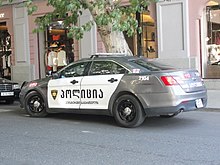 Georgian police car
Most of Georgia is very safe for foreigners. Crime rates are among the lowest in Europe. The Georgian Ministry of Internal Affairs provides some useful information for foreign visitors.
Corruption, once a big hassle for tourists, has become far less visible since the Rose Revolution. It is now safe and reasonable to trust the Georgian police, as the infamous and corrupt traffic police have been disbanded. Police cars patrol streets in Georgian cities and towns regularly, and can help in case of car trouble or any other problem on the road.
Use of seat belts is now obligatory and strictly enforced. Radars are installed at all main junctures and on key streets and highways throughout the country. However, Georgia leads the South Caucasus in reported road traffic accidents. A person is injured every hour in a traffic-related accident, while one death occurs every 18 hours, according to a study released by a Georgian NGO, the Safe Driving Association. The World Health Organization puts the number at 16.8 fatalities per 100,000 a year (compared to Azerbaijan at 13 and Armenia at 13.9).
...Read moreStay safeRead less Georgian police car
Most of Georgia is very safe for foreigners. Crime rates are among the lowest in Europe. The Georgian Ministry of Internal Affairs provides some useful information for foreign visitors.
Corruption, once a big hassle for tourists, has become far less visible since the Rose Revolution. It is now safe and reasonable to trust the Georgian police, as the infamous and corrupt traffic police have been disbanded. Police cars patrol streets in Georgian cities and towns regularly, and can help in case of car trouble or any other problem on the road.
Use of seat belts is now obligatory and strictly enforced. Radars are installed at all main junctures and on key streets and highways throughout the country. However, Georgia leads the South Caucasus in reported road traffic accidents. A person is injured every hour in a traffic-related accident, while one death occurs every 18 hours, according to a study released by a Georgian NGO, the Safe Driving Association. The World Health Organization puts the number at 16.8 fatalities per 100,000 a year (compared to Azerbaijan at 13 and Armenia at 13.9).
Women should be aware that many Georgian men do not believe "no" means no. They believe that no means maybe and maybe means yes. It is not uncommon for men to be very pushy with foreign women in particular. It is best to stay with groups and not to smile or give men attention. If you make a Georgian friend or get to know a Georgian man well, they will take care of you when you go out. There are many kinds of Georgian men, but keep your guard up. As for dressing, follow the general rules of being more conservative in the countryside than in cities. An easy way to avoid unwanted attention is to cover your legs. Georgian girls don't show a lot of leg even in summer, so even a naughty hint of knee can elicit public ogles. Conversely, tight clothes are fairly standard.
According to new marijuana laws, as of early 2019 it is decriminalized to be actively smoking a joint but not legal to have marijuana in your possession (or to sell, etc.) If you are out with young Georgians, you're likely to be invited to smoke, but even if you find somewhere, usually best not to risk actually buying it. It's not great quality outside of Svanetia anyway.
Taking picture inside of churches is not welcome, and taking a picture of a priest in churches is an offence and even a crime.
The display of Soviet symbols is illegal in Georgia, with only limited exceptions within Stalin's hometown of Gori.
TbilisiThings in Tbilisi and the surrounding countryside have calmed down a lot. Although Tbilisi sometimes has been singled out for its (not always deserved) reputation for street crime, muggings are rather rare.
In the early 2000s, other crime-related hazards in Tbilisi included apartment break-ins and car-jacking, but the situation has changed dramatically, and today Georgia boasts one of the lowest crime rates in Europe.
KutaisiThe available evidence indicates that Kutaisi, the second largest city in Georgia, suffers from crime rates significantly higher than the national average. It is very important to exercise caution in Kutaisi after dark.
AdjaraThe conflict between Adjara and the central government ended with little violence, and it is now perfectly safe to travel throughout the region. The once rampant corruption should now be a rarity for foreigners. Passing through customs at the Sarpi-Hopa border crossing is now routine and uneventful for most tourists, though at certain times it may take two hours or longer, due to long queues.
Separatist regionsAbkhazia and South Ossetia pose challenges for visitors, South Ossetia more than Abkhazia. Abkhazia is easy enough to visit, provided attention is paid to paperwork and border crossings. South Ossetia remains more untamed.
LGBT travellersWhile support of LGBT rights has been slowly increasing among the general public over the past several years, homosexuality is considered a major deviation from highly traditional Orthodox Christian values prevalent in the country, where public discussions of sexuality in general tend to be viewed in a highly negative light.
Georgia prohibits discrimination against all LGBT people in legislation, labor-related or otherwise (one of few former Soviet countries that does). Since 2012, Georgian law has considered crimes committed on the grounds of one's sexual orientation or gender identity an aggravating factor in prosecution.
Homosexuals are often targets of abuse and physical violence, often actively encouraged by religious leaders. LGBT persons must exercise maximal caution when showing affection towards a person of the same sex. Doing this anywhere outside the capital centre or designated spaces might result in violence.
Hugging, kissing on the cheek and touching in public between heterosexual men is pretty common and is an innate part of the Caucasian culture. Hence, such actions between partners are often unnoticed, but they are still dangerous if they show you are more than friends.
There are one or two places in the country that are safe places for LGBT people: one of them is the Bassiani club, which has a weekly LGBT night.


![[node:title]](/sites/default/files/styles/640x320/public/default_images/default_0.JPG.webp?itok=aqV9zhFR)