
Països Catalans
Catalan CountriesContext of Catalan Countries
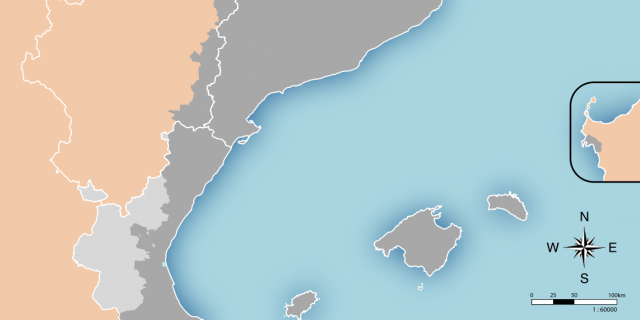
The Catalan Countries (Catalan: Països Catalans, Eastern Catalan: [pəˈizus kətəˈlans]) are those territories where the Catalan language is spoken. They include the Spanish regions of Catalonia, the Balearic Islands, Valencian Community, and parts of Aragon (La Franja) and Murcia (Carche), as well as the Principality of Andorra, the department of Pyrénées-Orientales (aka Northern Catalonia, including Cerdagne, Roussillon, and Vallespir) in France, and the city of Alghero in Sardinia (Italy). It is often used as a sociolinguistic term to describe the cultural-linguistic area where Catalan is spoken. In the context of Catalan nationalism, the term is sometimes used in a more restricted way to refer to just Catalonia, Valencia and the Balearic Islands. The Catalan Countries do not correspond to any present or past political or administrative unit, though most of the...Read more
The Catalan Countries (Catalan: Països Catalans, Eastern Catalan: [pəˈizus kətəˈlans]) are those territories where the Catalan language is spoken. They include the Spanish regions of Catalonia, the Balearic Islands, Valencian Community, and parts of Aragon (La Franja) and Murcia (Carche), as well as the Principality of Andorra, the department of Pyrénées-Orientales (aka Northern Catalonia, including Cerdagne, Roussillon, and Vallespir) in France, and the city of Alghero in Sardinia (Italy). It is often used as a sociolinguistic term to describe the cultural-linguistic area where Catalan is spoken. In the context of Catalan nationalism, the term is sometimes used in a more restricted way to refer to just Catalonia, Valencia and the Balearic Islands. The Catalan Countries do not correspond to any present or past political or administrative unit, though most of the area belonged to the Crown of Aragon in the Middle Ages. Parts of Valencia (Spanish) and Catalonia (Occitan) are not Catalan-speaking.
The "Catalan Countries" have been at the centre of both cultural and political projects since the late 19th century. Its mainly cultural dimension became increasingly politically charged by the late 1960s and early 1970s, as Francoism began to die out in Spain, and what had been a cultural term restricted to connoisseurs of Catalan philology became a divisive issue during the Spanish Transition period, most acrimoniously in Valencia during the 1980s. Modern linguistic and cultural projects include the Institut Ramon Llull and the Fundació Ramon Llull, which are run by the governments of the Balearic Islands, Catalonia and Andorra, the Department Council of the Pyrénées-Orientales, the city council of Alghero and the Network of Valencian Cities. Politically, it involves a pan-nationalist project to unite the Catalan-speaking territories of Spain and France, often in the context of the independence movement in Catalonia, but it is also simply a project for cultural unity, so that the linguistic area can have barriers to communication and interchange removed. The marginal political project of independence under Catalonia does not currently enjoy wide support, particularly outside Catalonia, where some sectors view it as an expression of pancatalanism. Linguistic unity is widely recognized, except for the followers of a political movement known as Blaverism, which understands Valencian as a different language.
More about Catalan Countries
- Currency Euro
- Native name Països Catalans
- Internet domain .cat
- Driving side right