
Chiapas
Context of Chiapas
Chiapas, officially the Free and Sovereign State of Chiapas, is one of the states that make up the 32 federal entities of Mexico. It comprises 124 municipalities as of September 2017 and its capital and largest city is Tuxtla Gutiérrez. Other important population centers in Chiapas include Ocosingo, Tapachula, San Cristóbal de las Casas, Comitán, and Arriaga. Chiapas is the southernmost state in Mexico, and it borders the states of Oaxaca to the west, Veracruz to the northwest, and Tabasco to the north, and the Petén, Quiché, Huehuetenango, and San Marcos departments of Guatemala to the east and southeast. Chiapas has a significant coastline on the Pacific Ocean to the southwest.
In general, Chiapas has a humid, tropical climate. In the northern area bordering Tabasco, near Teapa, rainfall can average more than 3,000 mm (120 in) per year. In the past, natural vegetation in this region was lowland, tall perennial rainforest, but this vegetation has been almost co...Read more
Chiapas, officially the Free and Sovereign State of Chiapas, is one of the states that make up the 32 federal entities of Mexico. It comprises 124 municipalities as of September 2017 and its capital and largest city is Tuxtla Gutiérrez. Other important population centers in Chiapas include Ocosingo, Tapachula, San Cristóbal de las Casas, Comitán, and Arriaga. Chiapas is the southernmost state in Mexico, and it borders the states of Oaxaca to the west, Veracruz to the northwest, and Tabasco to the north, and the Petén, Quiché, Huehuetenango, and San Marcos departments of Guatemala to the east and southeast. Chiapas has a significant coastline on the Pacific Ocean to the southwest.
In general, Chiapas has a humid, tropical climate. In the northern area bordering Tabasco, near Teapa, rainfall can average more than 3,000 mm (120 in) per year. In the past, natural vegetation in this region was lowland, tall perennial rainforest, but this vegetation has been almost completely cleared to allow agriculture and ranching. Rainfall decreases moving towards the Pacific Ocean, but it is still abundant enough to allow the farming of bananas and many other tropical crops near Tapachula. On the several parallel sierras or mountain ranges running along the center of Chiapas, the climate can be quite moderate and foggy, allowing the development of cloud forests like those of Reserva de la Biosfera El Triunfo, home to a handful of horned guans, resplendent quetzals, and azure-rumped tanagers.
Chiapas is home to the ancient Mayan ruins of Palenque, Yaxchilán, Bonampak, Lacanha, Chinkultic, El Lagartero and Toniná. It is also home to one of the largest indigenous populations in the country, with twelve federally recognized ethnicities.
More about Chiapas
- Population 5217908
- Area 73311
- Stay safe
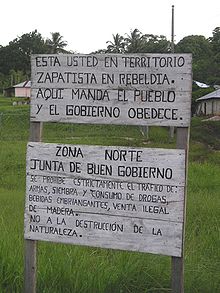 A sign outside of an autonomous Zapatista village in Chiapas. It reads (top): "You are in Zapatista rebel territory. Here, the people give the orders and the government obeys." Bottom: "North Zone. Council of Good Government. It is strictly prohibited to traffic weapons, plant or use drugs, drink alcoholic beverages, or sell wood illegally. No to the destruction of nature."
Be aware of your personal belongings all the time, and do not walk with jewelry and expensive objects in sight. Chiapas is usually in secure state, where the warmth of people will make you feel at home.
Much of the northeastern portion of Chiapas is fully or partially under the protection of the Zapatista Army of National Liberation, or the EZLN. These areas have declared themselves as autonomous, and are referred to as the Rebel Zapatista Autonomous Municipalities, or MAREZ. The EZLN have been in this area since 1 January 1994, the day that NAFTA went into effect. Though they might wear black masks and carry guns, they likely will not harm you unless you are shouting praises of the Mexican army. The EZLN are not a gang or cartel; they are a decentralized organization dedicated to libertarian socialist principles who oppose the exploitative capitalist practices and destructive environmental policies of the Mexican government. Many of the people living under the Zapatista umbrella support their presence, as they provide many essential public services that the Mexican government has been unable, or unwilling, to provide. Though relations between the EZLN and the Mexican government have been rather peaceful in the 21st century, skirmishes between them have been known to occur. There are also anti-Zapatista militias who have carried out massacres of EZLN members and suspected sympathizers. Respect their rules when you are in their territory, stay aware of any potential flashpoints, and you will probably be fine.


![[node:title]](/sites/default/files/styles/640x320/public/default_images/default_0.JPG.webp?itok=aqV9zhFR)