
New Zealand
Context of New Zealand
New Zealand (Māori: Aotearoa) is an island country in the southwestern Pacific Ocean. It consists of two main landmasses—the North Island (Te Ika-a-Māui) and the South Island (Te Waipounamu)—and over 600 smaller islands. It is the sixth-largest island country by area and lies east of Australia across the Tasman Sea and south of the islands of New Caledonia, Fiji, and Tonga. The country's varied topography and sharp mountain peaks, including the Southern Alps (Kā Tiritiri o te Moana), owe much to tectonic uplift and volcanic eruptions. New Zealand's capital city is Wellington, and its most populous city is Auckland.
The islands of New Zealand were the last large habitable land to be settled by humans. Between about 1280 and 1350, Polynesians began t...Read more
New Zealand (Māori: Aotearoa) is an island country in the southwestern Pacific Ocean. It consists of two main landmasses—the North Island (Te Ika-a-Māui) and the South Island (Te Waipounamu)—and over 600 smaller islands. It is the sixth-largest island country by area and lies east of Australia across the Tasman Sea and south of the islands of New Caledonia, Fiji, and Tonga. The country's varied topography and sharp mountain peaks, including the Southern Alps (Kā Tiritiri o te Moana), owe much to tectonic uplift and volcanic eruptions. New Zealand's capital city is Wellington, and its most populous city is Auckland.
The islands of New Zealand were the last large habitable land to be settled by humans. Between about 1280 and 1350, Polynesians began to settle in the islands and subsequently developed a distinctive Māori culture. In 1642, the Dutch explorer Abel Tasman became the first European to sight and record New Zealand. In 1769 the British explorer Captain James Cook became the first European to set foot on and map New Zealand. In 1840, representatives of the United Kingdom and Māori chiefs signed the Treaty of Waitangi which paved the way for Britain's declaration of sovereignty later that year and the establishment of the Crown Colony of New Zealand in 1841. Subsequently, a series of conflicts between the colonial government and Māori tribes resulted in the alienation and confiscation of large amounts of Māori land. New Zealand became a dominion in 1907; it gained full statutory independence in 1947, retaining the monarch as head of state. Today, the majority of New Zealand's population of 5.25 million is of European descent; the indigenous Māori are the largest minority, followed by Asians and Pasifika. Reflecting this, New Zealand's culture is mainly derived from Māori and early British settlers but has recently broadened from increased immigration. The official languages are English, Māori, and New Zealand Sign Language, with the local dialect of English being dominant.
A developed country, New Zealand was the first to introduce a minimum wage and give women the right to vote. It ranks very highly in international measures of quality of life and human rights and has one of the lowest levels of perceived corruption in the world. It retains visible levels of inequality, including structural disparities between its Māori and European populations. New Zealand underwent major economic changes during the 1980s, which transformed it from a protectionist to a liberalised free-trade economy. The service sector dominates the national economy, followed by the industrial sector, and agriculture; international tourism is also a significant source of revenue. New Zealand and Australia have a strong relationship and are considered to share a strong Trans-Tasman identity, stemming from centuries of British colonisation. The country is part of multiple international organizations and forums.
Nationally, legislative authority is vested in an elected, unicameral Parliament, while executive political power is exercised by the Government, led by the prime minister, currently Christopher Luxon. Charles III is the country's king and is represented by the governor-general, Cindy Kiro. New Zealand is organised into 11 regional councils and 67 territorial authorities for local government purposes. The Realm of New Zealand also includes Tokelau (a dependent territory); the Cook Islands and Niue (self-governing states in free association with New Zealand); and the Ross Dependency, which is New Zealand's territorial claim in Antarctica.
More about New Zealand
- Currency New Zealand dollar
- Native name New Zealand
- Calling code +64
- Internet domain .nz
- Mains voltage 230V/50Hz
- Democracy index 9.25
- Population 5118700
- Area 268021
- Driving side left
- Stay safe
The main emergency number in New Zealand is 111, and can be used to contact ambulance, the fire service, police, the coastguard, and rescue services. 112 works from mobile phones; 911 and 999 may work, but do not rely on them. You can call *555 from mobiles to report non-emergency traffic incidents. You can call 105 for non-emergency police, e.g. to report a theft or burglary (from overseas, you can call ☏ +64 4 910-5105 to reach 105).
Deaf people can contact emergency services by fax on 0800 16 16 10, and by textphone/TTY on 0800 161 616. It is possible to send an SMS to 111, but you must register with police first.
Full instructions are on the inside front cover of every telephone book. Other emergency numbers and personal crisis numbers are on pages 2 to 4 of the white pages section.
Crime and security Police officers in Auckland
While difficult to make direct international comparisons, the level of crime in New Zealand is lower than in most other western countries. Dishonesty offences, such as theft, are by far the most frequent crime. Much of this crime is opportunistic in nature, so travellers should take simple, sensible precautions such as putting valuables away out of sight or in a secure place and locking doors of vehicles, even in remote locations.
...Read moreStay safeRead lessThe main emergency number in New Zealand is 111, and can be used to contact ambulance, the fire service, police, the coastguard, and rescue services. 112 works from mobile phones; 911 and 999 may work, but do not rely on them. You can call *555 from mobiles to report non-emergency traffic incidents. You can call 105 for non-emergency police, e.g. to report a theft or burglary (from overseas, you can call ☏ +64 4 910-5105 to reach 105).
Deaf people can contact emergency services by fax on 0800 16 16 10, and by textphone/TTY on 0800 161 616. It is possible to send an SMS to 111, but you must register with police first.
Full instructions are on the inside front cover of every telephone book. Other emergency numbers and personal crisis numbers are on pages 2 to 4 of the white pages section.
Crime and security Police officers in Auckland
While difficult to make direct international comparisons, the level of crime in New Zealand is lower than in most other western countries. Dishonesty offences, such as theft, are by far the most frequent crime. Much of this crime is opportunistic in nature, so travellers should take simple, sensible precautions such as putting valuables away out of sight or in a secure place and locking doors of vehicles, even in remote locations.
Violent crime in public places is associated with alcohol or illicit drug consumption. Rowdy bars or drunken crowds in city centres, or groups of youths in the suburbs, are best avoided, especially late at night and in the early morning. New Zealanders can be somewhat uptight and lacking in a sense of humour when their country or their sporting teams are mocked by loud or drinking tourists.
There are occasional disturbing high profile media reports of tourists being targeted in random violent robberies and sexual crimes. These crimes tend to happen in isolated places, where the chances of the offender being observed by other people are low. However, the chances of falling victim to such misfortune is low; statistics show you're more likely to be attacked by someone in your travelling party than a complete stranger.
A major terrorist attack occurred in Christchurch on 15 March 2019, in which a white supremacist carried out consecutive shootings on two mosques, killing 51 people. However, the long-term terrorist threat in New Zealand is similar to other Western countries.
The New Zealand Police is the national police force, and police officers are generally polite, helpful and trustworthy. Unlike in most other nations, New Zealand police officers do not routinely wear firearms, but have them in their cars, only taking them out when necessary; the exception is those guarding key installations such as airports, diplomatic missions and some government buildings. Officers on the beat typically only carry batons, offender control pepper spray, and Tasers. Firearm-related incidents are typically left to the specialist Armed Offenders Squad (AOS, similar to SWAT in the United States) to deal with when possible. Armed police or an AOS callout usually rates a mention in the media.
Police fines can be paid online by credit card or internet banking, by posting a cheque or in person at any branch of Westpac Bank. Do not try to pay the police officer directly as this is considered bribery and will be dealt with accordingly.
RacismNew Zealand is in general a fairly tolerant country with respect to race, and most visitors to New Zealand do not run into any incidents. While it is not particularly difficult to encounter someone who has racist views in the pub, it is in general rare to face open aggression in the street on the basis of one's race. Legislation prohibits hate speech and racial discrimination in a wide range of public spheres such as education and employment. New Zealanders are very open-minded people, yet the country's extreme isolation means that certain ethnicities are not as prevalent there as in places like the USA. People who are of African or Latin American descent might, for example, attract stares in remote areas of New Zealand. This is more out of curiosity than racism.
Illicit drugsMost illicit drugs, including preparations, precursor substances and paraphernalia, are illegal to possess and to deal in New Zealand. Possession of illicit drugs is punishable by up to 6 months in prison, although it is rare for offenders to get more than a fine or community service. Police may offer diversion for possession of cannabis or another class C drug (e.g. barbiturates, benzodiazepines) as an alternative to being convicted in court. New Zealand has a "presumption of supply law", which means if you're found in possession drugs above a certain quantity (0.5 grams for cocaine and heroin, 5 grams for methamphetamine, 28 grams for cannabis), you'll be presumed to be a supplier and will be charged with dealing in drugs rather than possession.
The penalties for dealing in illicit drugs, whether it be importing/exporting, trafficking, manufacturing, cultivating or selling, are much stiffer than for possession; dealing in class A drugs (e.g. heroin, cocaine, LSD, methamphetamine) can attract a sentence of life imprisonment with the possibility of parole after 10 years.
A referendum on legalising cannabis in New Zealand was held alongside the 2020 general election, but failed by a narrow margin (50.7% opposed to 48.4% in favour).
Natural hazardsSevere weather is by far the most common natural hazard encountered. Although New Zealand is not subject to the direct hit of tropical cyclones, stormy weather systems from both the tropics and the polar regions can sweep across New Zealand at various times of the year. There is generally a seven to ten day cycle of a few days of wet or stormy weather followed by calmer and drier days as weather systems move across the country. The phrase four seasons in one day is a good description of New Zealand weather, which has a reputation for both changeability and unpredictability. The phrase is also a popular Kiwi song.
Weather forecasts are generally reliable for overall trends and severe weather warnings should be heeded when broadcast. However both the timing and intensity of any weather events should be assessed from your own location.
You should always seek advice from the Department of Conservation when trekking in alpine areas. There are annual fatalities of both foreign nationals and New Zealanders caught unaware by the weather.
There are other natural hazards you may encounter, though far more rarely:
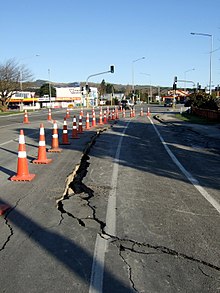 Earthquake damage to a roadStrong earthquakes - New Zealand, being part of the Pacific Ring of Fire, sits astride a tectonic plate boundary and experiences large numbers (about 14,000/year) of earthquakes every year, although only around 200 are strong enough to be felt by humans and only 1-2 causes any material damage. Only two recorded earthquakes in New Zealand have resulted in serious loss of life; the 1931 Hawke's Bay earthquake (7.8 magnitude, 256 dead), and the 2011 Christchurch earthquake (6.3 magnitude, 185 dead). The latest quake news is reported by GeoNet. In an earthquake, running outside the building is generally more hazardous than remaining inside and finding cover; buildings in New Zealand are built to high standards, and while they may be damaged in an earthquake, they should remain standing.If you do feel a strong earthquake, remember Drop, Cover, Hold: drop to the ground, cover yourself under a table or desk (or cover your head and neck with your hands if no table or desk is available), and hold on until the shaking stops.Tsunami is a possible risk in coastal parts of New Zealand. Warning of a tsunami from an overseas earthquake will be widely publicised via media. However, should you experience a very strong earthquake (over a minute long, or so strong you cannot easily stand) you should move to high ground (35 m or more) or at least 1km inland as a precaution until an all clear is given. Volcanic eruptions - New Zealand has a number of volcanoes that are classified as active or dormant. Active volcanoes include Mount Ruapehu, Tongariro, White Island and the remote Kermadec Islands. Volcanic activity is also monitored by GeoNet. There are almost no poisonous or dangerous animals. The katipo and Australian redback are the only two venomous spiders and bites from both species are extremely rare. Serious reactions are uncommon and unlikely to develop in less than three hours, though you should always seek help at your nearest hospital, medical centre, or doctor. The bite of the white-tailed spider is painful but not in fact, despite folklore, especially dangerous to humans. Certain ferocious-looking species of wētā (a giant flightless cricket) can deliver a painful but harmless bite. New Zealand has no wolves, bears, big cats, crocodiles or other predators, and no snakes at all: it's safe to walk alone in the bush, or even lie down and have a nap.Volunteer fire brigade sirens
Outside the major cities, New Zealanders rely on volunteer fire brigades to protect their community. As mobiles and pagers have a tendency to fail, sirens are still regularly used day and night to call out firefighters. These sirens sound similar to British World War II air-raid sirens, and make a wailing (up and down) sound. Don't be alarmed if the siren goes off: tourists in the past have been caught unaware and have panicked thinking New Zealand was under nuclear attack!
FirearmsNew Zealand does not have constitutional rights with regards to firearm ownership, and possession of any type of firearm requires a licence from the police. The standard firearms licence only allow the person to possess sporting type shotguns and rifles, and for pre-charged pneumatic (PCP) air rifles; semi-automatic weapons and military-grade assault rifles are illegal for civilians to possess, and all other types of firearms require an additional endorsement. Air weapons, and PCP airsoft and paintball rifles, are an exception to this rule, and may be purchased by anybody over the age of 18 without a licence. It is extremely rare for civilians to carry firearms in urban areas, and doing so would likely draw suspicion from the public and police.
Visitors who wish to bring firearms into New Zealand are required to obtain a permit from the police at least one month before arrival. In practice receiving one is difficult, and is only possible if you are entered in an official shooting competition or are travelling for hunting.