
Bali
Context of Bali
Bali (English:; Balinese: ᬩᬮᬶ) is a province of Indonesia and the westernmost of the Lesser Sunda Islands. East of Java and west of Lombok, the province includes the island of Bali and a few smaller offshore islands, notably Nusa Penida, Nusa Lembongan, and Nusa Ceningan to the southeast. The provincial capital, Denpasar, is the most populous city in the Lesser Sunda Islands and the second-largest, after Makassar, in Eastern Indonesia. Denpasar metropolitan area is the extended metropolitan area around Denpasar. The upland town of Ubud in Greater Denpasar is considered Bali's cultural centre. The province is Indonesia's main tourist destination, with a significant rise in tourism since the 1980s, and becoming an Indonesian area of overtourism. Tourism-related business makes up 80% of the Bali economy.
Bali is the only Hindu-majority province in Indonesia, with 86.9% of the population ...Read more
Bali (English:; Balinese: ᬩᬮᬶ) is a province of Indonesia and the westernmost of the Lesser Sunda Islands. East of Java and west of Lombok, the province includes the island of Bali and a few smaller offshore islands, notably Nusa Penida, Nusa Lembongan, and Nusa Ceningan to the southeast. The provincial capital, Denpasar, is the most populous city in the Lesser Sunda Islands and the second-largest, after Makassar, in Eastern Indonesia. Denpasar metropolitan area is the extended metropolitan area around Denpasar. The upland town of Ubud in Greater Denpasar is considered Bali's cultural centre. The province is Indonesia's main tourist destination, with a significant rise in tourism since the 1980s, and becoming an Indonesian area of overtourism. Tourism-related business makes up 80% of the Bali economy.
Bali is the only Hindu-majority province in Indonesia, with 86.9% of the population adhering to Balinese Hinduism. It is renowned for its highly developed arts, including traditional and modern dance, sculpture, painting, leather, metalworking, and music. The Indonesian International Film Festival is held every year in Bali. Other international events that have been held in Bali include Miss World 2013, the 2018 Annual Meetings of the International Monetary Fund and the World Bank Group and the 2022 G20 summit. In March 2017, TripAdvisor named Bali as the world's top destination in its Traveller's Choice award, which it also earned in January 2021.
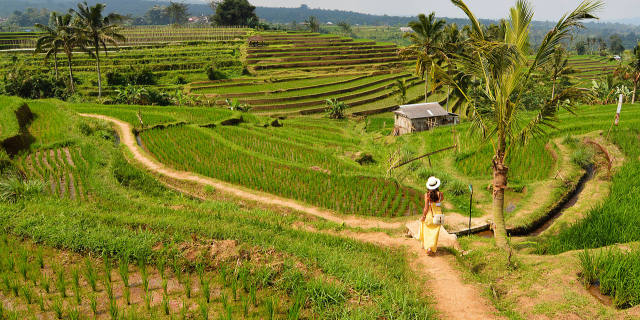
Bali is part of the Coral Triangle, the area with the highest biodiversity of marine species, in Coral Triangle, especially fish and turtles. In this area alone, over 500 reef-building coral species can be found. For comparison, this is about seven times as many as in the entire Caribbean. Bali is the home of the Subak irrigation system, a UNESCO World Heritage Site. It is also home to a unified confederation of kingdoms composed of 10 traditional royal Balinese houses, each house ruling a specific geographic area. The confederation is the successor of the Bali Kingdom. The royal houses, which originated before Dutch colonisation, are not recognised by the government of Indonesia.
More about Bali
- Population 4362700
- Area 5780
- Stay safe
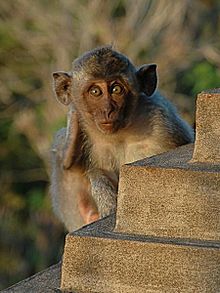 Behind the cuddly façade lies a cunning thief
Bali is, in general, a safe destination, and few visitors encounter any real problems.
Bali was the scene of lethal terrorist bombings in 2002 and 2005, with both waves of attacks targeting nightclubs and restaurants popular among foreign visitors. Security is consequently tight at obvious targets, but it is of course impossible to protect oneself fully against terrorism. If it is any reassurance, the Balinese themselves—who depend on tourism for their livelihood—deplored the bombings and the terrorists behind them for the terrible suffering they have caused on this peaceful island. As a visitor, it is important to put the risk in perspective: Bali's roads are statistically far more dangerous than even the deadliest bomb. It may still be prudent to avoid high profile Western hangouts, especially those without security measures. The paranoid or just security-conscious may wish to head out of the tourist enclaves of South Bali to elsewhere on the island.
...Read moreStay safeRead less
Behind the cuddly façade lies a cunning thiefBali is, in general, a safe destination, and few visitors encounter any real problems.
Bali was the scene of lethal terrorist bombings in 2002 and 2005, with both waves of attacks targeting nightclubs and restaurants popular among foreign visitors. Security is consequently tight at obvious targets, but it is of course impossible to protect oneself fully against terrorism. If it is any reassurance, the Balinese themselves—who depend on tourism for their livelihood—deplored the bombings and the terrorists behind them for the terrible suffering they have caused on this peaceful island. As a visitor, it is important to put the risk in perspective: Bali's roads are statistically far more dangerous than even the deadliest bomb. It may still be prudent to avoid high profile Western hangouts, especially those without security measures. The paranoid or just security-conscious may wish to head out of the tourist enclaves of South Bali to elsewhere on the island.
Bali is increasingly enforcing Indonesia's harsh penalties against the import, export, trafficking and possession of illegal drugs, including marijuana, ecstasy, cocaine and heroin. Several high profile arrests of foreigners have taken place in Bali since 2004, and a number have been sentenced to lengthy prison terms or (very rarely) execution. Even the possession of a small amount of drugs for personal use puts you at risk of a trial and prison sentence. Watch out for seemingly harmless street boys looking to sell you drugs (marijuana, ecstasy, cocaine, etc.). More often than not, they are working with undercover police and will try to sell you drugs so that they can then get uniformed officers onto you. The police officers will (if you are lucky) demand a bribe for your release, or, more likely, look for a far larger payday by taking you into custody. Just avoid Bali's drug scene at all costs.
The unfortunate people who are caught and processed will find there is little distinction between personal use and dealing in the eyes of the Indonesian legal system. 'Expedition fees', monies paid to shorten prison sentences can easily be US$20,000 and are often a lot more.
There is a fair chance that you will be offered magic mushrooms, especially if you are young and find yourself in Kuta. Indonesian law is a little unclear in this area but with the whole country in the midst of a drug crackdown since 2004, it is not worth taking the risk.
 Don't swim near the red flag(s); swim between two yellow flags, if there are any
If you see a red flag planted in the sand, do not swim there, as they are a warning of dangerous rip currents. These currents can pull you out to sea with alarming speed and even the strongest swimmers cannot swim against them. The thing to do is to stay calm and swim sideways (along the shore) until out of the rip and only then head for the shore. The ocean is not to be trifled with in Bali, and dozens of people, some experienced some not, die by drowning every year.
ScamsEven though Bali is quite a safe place in which few tourists encounter problems, avoid scams and overpriced services this island can offer you.
Petty scams are not uncommon, although they can usually be avoided with a modicum of common sense. If approached on the street by anybody offering a deal on souvenirs, transport, etc., you can rest assured that you will pay more if you follow your new found friend. Guard your bags, especially at transport terminals and ferry terminals. In addition to the risk of them being stolen, self-appointed porters like to grab them without warning and then insist on ridiculous prices for their "services".
Timeshare scams and schemes are common in Bali with several high profile, apparently legitimate operators. If you are approached by a very friendly street canvasser asking you to complete a survey and then attend a holiday resort presentation to claim your 'prize' (this is inevitably a 'free' holiday which you end up paying for anyway), politely refuse and walk away. You may also be cold-called at your hotel to be told you have 'won a holiday' - the caller may even know your name and nationality thanks to a tip-off from someone who has already seen your data. If you fall for this scam, you will be subjected to a very long, high pressure sales presentation and if you actually buy the 'holiday club' product, you will certainly regret it. Timeshare is a completely unregulated industry in Indonesia, and you have no recourse.
When leaving Bali, if you have anything glass in your baggage (such as duty-free alcohol) the security guards may put some pressure on you to have it wrapped to keep it safe, and it can seem like its a requirement rather than a suggestion (it is Rp 60,000 a bag). Similarly, when arriving in Bali, some uniformed airport porters may offer to take your bags for you and walk you through customs, be generally friendly and helpful, and then demand a tip. The charge is Rp 5,000, a request for any amount in excess of this has no formal sanction, it is best to stop them from interfering with your bags in any way, just tell them you do not want their services unless you are sure you want to use them, if so clarify the price before they lift up your bags. These 'services' are best avoided.
The money changing rule is simple: use only authorised money changers with proper offices and always ask for a receipt. The largest is called PT Central Kuta and they have several outlets. If you are especially nervous, then use a formal bank. You may get a better rate at an authorised money changer though.
Avoid changing money in smaller currency exchange offices in shops, as they more often than not will try to steal money by using very creative and "magician" like methods. Even when you think you've watched the dealers every move, you're not unlikely to end up with far too low an amount in your hands, so just take a minute to recount your stack of notes at the spot. Often the rate advertised on the street is nowhere near the rate that they will give you in the end. Many times the rate is set higher to lure you in so that they can con you out of a banknote or two, and when this is not possible, they will give you a shoddy rate and state that the difference is due to commission. This even applies to the places which clearly state that there is no commission, of course any money changer charges a commission, they would cease to be viable if they did not and it is built into the differential between the purchase rate and the sell rate at any given time.
For many, the largest irritant will be the hawkers and peddlers who linger around temples, malls, beaches, and anywhere tourists congregate. It may feel difficult or rude to ignore the constant come-ons to buy souvenirs, food and assorted junk, but it can be necessary in order to enjoy your holiday in semi-peace.
Be wary around the monkeys that occupy many temples (most notably Uluwatu and Ubud's Monkey Forest). They are experts at stealing possessions like glasses, cameras and even handbags, and have been known to attack people carrying food. Feeding them is just asking for trouble.
Rabies is present in Bali and several deaths arising from rabies infections have been recorded in early 2011. Visitors to the island should avoid contact with dogs, cats, monkeys and other animals that carry the disease. If bitten seek medical attention.
Whilst eating dog meat is not illegal in Bali, some vendors are breaching animal cruelty and food safety laws. Dogs are being bludgeoned, strangled or poisoned for human consumption. Dog meat is filtering into the tourist food chain in Bali, sometimes unsafely.
"Turtle Island" scamA "Turtle ‘Island’" in Tanjung Benoa is one of Bali's most infamous scams. Bali does possess a legitimate Turtle Conservation and Education Center (TCEC) at Serangan Island, also known as "Turtle Island", which is sponsored by the government (to be exact, the Ministry of Environment and Forestry [Kementerian Lingkungan Hidup dan Kehutanan]). However, when requested to go to "Turtle Island", many drivers, guides, and tour agencies will instead lead tourists to an unlicensed "conservation center" called Moon Cot Sari there. It is more of a mini-zoo than a conservation centre, despite its name. What’s wrong with this place is that animals are kept in filthy, small habitat and subject to several forms of mistreatment. For instance, the snakes are kept there with their mouths taped, while the turtles (which really are solitary animals) were packed into several murky, small-for-turtle pens. Civets were kept in dirty cages which allows them to experience improper breeding and stimulation. Furthermore, tourists are subject to high-price services being offered on the departure spot leading there - that is, at BMR Watersport. There, you will be led into boats that take you to that place, which is actually not in an island - that is, it is accessible by land (not just water). These boat trips are generally expensive, and stop for a while at a very small coral reef situated offshore, where several boats also wait, before going to your final destination - the "turtle ‘island’".
It is all part of a system - guides, drivers, and tour agencies gets a cut (commission) from the company when they bring tourists there.
If you have any concern about animal welfare, make sure that you visit the licensed (and government-funded) TCEC at Serangan. Do not support any tour agencies, drivers, or guides, that attempt to lead tourists and locals to the fake "conservation center" at Tanjung Benoa.
Satria AgrowisataAnother scam in Bali involves a "coffee plantation" called Satria Agrowisata, which specialises on kopi luwak. In it, visitors are subject to luwaks that has been "drugged up" and exorbitant prices of their "tea"s and "coffee"s. Furthermore, while their "tea"s and "coffee"s are not really tea and coffee powder at all, but just useless sweet-tasting powder, with one review stating that it was just "kool-aid"; the ingredients are also not specified at all, with some claiming to be "sugar-free" but in fact it is sweet, so you will never know what are the actual contents of the product.
If you want to sample coffees, make sure that you go to Seniman Coffee Studio at Ubud. Also, do not support any tour agents, guides, or drivers that bring you into Satria Agrowisata or similar kopi luwak-based scams.


![[node:title]](/sites/default/files/styles/640x320/public/default_images/default_0.JPG.webp?itok=aqV9zhFR)