

Colombia
Context of Colombia
Colombia, officially the Republic of Colombia, is a country primarily located in South America with insular regions in North America. The Colombian mainland is bordered by the Caribbean Sea to the north, Venezuela to the east and northeast, Brazil to the southeast, Peru and Ecuador to the south and southwest, the Pacific Ocean to the west, and Panama to the northwest. Colombia is divided into 32 departments. The Capital District of Bogotá is also the country's largest city hosting the main financial and cultural hub. Other major urban areas include Medellín, Cali, Barranquilla, Cartagena, Santa Marta, Cúcuta, Ibagué, Villavicencio and Bucaramanga. It covers an area of 1,141,748 square kilometers (440,831 sq mi) and has a population of around 52 million. Its rich cultural heritage—including language, religion, cuisine, and art—reflects its history as a colony, fusing cultural elements brought by immigration from Europe and the Middle Eas...Read more
Colombia, officially the Republic of Colombia, is a country primarily located in South America with insular regions in North America. The Colombian mainland is bordered by the Caribbean Sea to the north, Venezuela to the east and northeast, Brazil to the southeast, Peru and Ecuador to the south and southwest, the Pacific Ocean to the west, and Panama to the northwest. Colombia is divided into 32 departments. The Capital District of Bogotá is also the country's largest city hosting the main financial and cultural hub. Other major urban areas include Medellín, Cali, Barranquilla, Cartagena, Santa Marta, Cúcuta, Ibagué, Villavicencio and Bucaramanga. It covers an area of 1,141,748 square kilometers (440,831 sq mi) and has a population of around 52 million. Its rich cultural heritage—including language, religion, cuisine, and art—reflects its history as a colony, fusing cultural elements brought by immigration from Europe and the Middle East, with those brought by the African diaspora, as well as with those of the various Indigenous civilizations that predate colonization. Spanish is the official language, although Creole, English and 64 other languages are recognized regionally.
Colombia has been home to many indigenous peoples and cultures since at least 12,000 BCE. The Spanish first landed in La Guajira in 1499, and by the mid-16th century, they had colonized much of present-day Colombia, and established the New Kingdom of Granada, with Santa Fe de Bogotá as its capital. Independence from the Spanish Empire is considered to have been declared in 1810, with what is now Colombia emerging as the United Provinces of New Granada. After a brief Spanish reconquest, Colombian independence was secured and the period of Gran Colombia began in 1819. The new polity experimented with federalism as the Granadine Confederation (1858) and then the United States of Colombia (1863), before becoming a centralised republic—the current Republic of Colombia—in 1886. With the backing of the United States and France, Panama seceded from Colombia in 1903, resulting in Colombia's present borders. Beginning in the 1960s, the country has suffered from an asymmetric low-intensity armed conflict and political violence, both of which escalated in the 1990s. Since 2005, there has been significant improvement in security, stability, and rule of law, as well as unprecedented economic growth and development. Colombia is recognized for its healthcare system, being the best healthcare in Latin America according to the World Health Organization and 22nd in the world. Its diversified economy is the third-largest in South America, with macroeconomic stability and favorable long-term growth prospects.
Colombia is one of the world's seventeen megadiverse countries; it has the highest level of biodiversity per square mile in the world and the second-highest level overall. Its territory encompasses Amazon rainforest, highlands, grasslands and deserts. It is the only country in South America with coastlines (and islands) along both the Atlantic and Pacific oceans. Colombia is a key member of major global and regional organizations including the UN, the WTO, the OECD, the OAS, the Pacific Alliance and the Andean Community; it is also a NATO Global Partner and a major non-NATO ally of the United States.
More about Colombia
- Currency Colombian peso
- Native name Colombia
- Calling code +57
- Internet domain .co
- Mains voltage 110V/60Hz
- Democracy index 7.04
- Population 52321152
- Area 1141748
- Driving side right
- Stay safe
 WARNING: Even though security in Colombia has increased significantly, violence linked to drug trafficking still affects a few, mainly rural, areas of the country. Specifically, kidnapping of foreign nationals for ransom still occurs from time to time. Visitors are urged to remain vigilant, especially outside major cities, and keep up to date with the latest government travel advisories....Read moreStay safeRead less WARNING: Even though security in Colombia has increased significantly, violence linked to drug trafficking still affects a few, mainly rural, areas of the country. Specifically, kidnapping of foreign nationals for ransom still occurs from time to time. Visitors are urged to remain vigilant, especially outside major cities, and keep up to date with the latest government travel advisories. Terrorist attacks continue — pay attention to warnings from local authorities.
Government travel advisories(Information last updated 17 Aug 2020)United Kingdom United States
WARNING: Even though security in Colombia has increased significantly, violence linked to drug trafficking still affects a few, mainly rural, areas of the country. Specifically, kidnapping of foreign nationals for ransom still occurs from time to time. Visitors are urged to remain vigilant, especially outside major cities, and keep up to date with the latest government travel advisories....Read moreStay safeRead less WARNING: Even though security in Colombia has increased significantly, violence linked to drug trafficking still affects a few, mainly rural, areas of the country. Specifically, kidnapping of foreign nationals for ransom still occurs from time to time. Visitors are urged to remain vigilant, especially outside major cities, and keep up to date with the latest government travel advisories. Terrorist attacks continue — pay attention to warnings from local authorities.
Government travel advisories(Information last updated 17 Aug 2020)United Kingdom United StatesColombia has suffered from a terrible reputation as a dangerous and violent country but the situation has improved dramatically since the 1980s and 1990s. Colombia is on the path to recovery, and Colombians are very proud of the progress they have made. These days, Colombia is generally safe to visit, with the violent crime rate being lower than that in Mexico or Brazil, as long as you avoid poorer areas of the cities at night, and do not venture off the main road into the jungle where guerrillas are likely to be hiding.
The security situation varies greatly around the country. The Travel Risk Map covers Colombia and shows the current safety levels throughout the country. Most jungle regions are not safe to visit, but the area around Leticia is very safe, and the areas around Santa Marta are OK. No one should visit the Darien Gap at the border with Panama (in the north of Chocó), Putumayo or Caquetá, which are very dangerous, active conflict zones. Other departments with significant rural violence include the Atlantic departments of Chocó, Cauca, and Valle del Cauca; eastern Meta, Vichada, and Arauca in the east; and all Amazonian departments except for Amazonas. That's not to say that these departments are totally off-limits—just be sure you are either traveling with locals who know the area or sticking to cities and tourist destinations. In general, if you stick to the main roads between major cities and do not wander off into remote parts of the jungle, you are unlikely to run into trouble, and you are much more likely to encounter a Colombian army checkpoint than an illegal guerrilla roadblock.
Landmines Graffiti on a wall in Bogota
Colombia is one of the most mine-affected countries in the world. So don't walk around blithely through the countryside without consulting locals. Land mines are found in 31 out of Colombia's 32 departments, and new ones are planted every day by guerrillas, paramilitaries, and drug traffickers.
ParamilitariesThere was an agreement in 2005 with the government which resulted in the disarmament of some of the paramilitaries. However they are still active in drug business, extortion rackets, and as a political force. They do not target tourists specifically, but running up against an illegal rural roadblock in more dangerous departments is possible.
KidnappingsAt the turn of the millennium Colombia had the highest rates of kidnapping in the world, a result of being one of the most cost-effective ways of financing for the guerrillas of the FARC and the ELN and other armed groups. Fortunately, the security situation has much improved and the groups involved are today much weakened, with the number of kidnappings dropping from 3,000 in 2000 down to 205 cases in 2016. Today kidnappings are still a problem in some southern departments like Valle del Cauca, Cauca, and Caquetá. Colombian law makes the payment of ransom illegal, therefore the police may not be informed in some circumstances.
GuerrillasThe guerrilla movements which include FARC and ELN guerrillas are still operational, though they are greatly weakened compared to the 1990s as the Colombian army has killed most of their leaders. These guerrillas operate mainly in rural parts of southern, southeastern and northwestern Colombia, although they have a presence in 30 out of the country's 32 departments. Big cities hardly ever see guerrilla activity these days. Even in rural areas, if you stick to the main roads between major cities and do not wander off the beaten track, you are far more likely to encounter soldiers from the Colombian army than guerrillas. River police, highway police, newspapers, and fellow travelers can be a useful source of information off-the-beaten-path.
Crime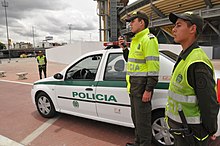 Colombian police officers next to a patrol car
The crime rate in Colombia has been significantly reduced since its peak in the late 1980s and 1990s, with the police having arrested or killed many of the important leaders of the drug cartels. However, major urban centers and the countryside of Colombia still have very high violent crime rates, comparable to blighted cities in the United States, and crime has been on the increase. In the downtown areas of most cities (which rarely coincide with the wealthy parts of town) violent crime is not rare; poor sections of cities can be quite dangerous for someone unfamiliar with their surroundings. Taxi crime is a very serious danger in major cities, so always request taxis by phone or app, rather than hailing them off the street—it costs the same and your call will be answered rapidly. Official taxi ranks are safe as well (airports, bus terminals, shopping malls).
DrugsLocal consumption is low, and penalties are draconian, owing to the nation's well-known largely successful fight against some of history's most powerful and dangerous traffickers. Remember that the drug trade in Colombia has ruined many innocent citizens' lives and dragged the country's reputation through the mud.
Marijuana is illegal to buy and sell, although officially you can carry up to 20 grams without being charged for it. Police will tolerate you having a few grams of this drug on your person, but you are flirting with danger if you carry much more. Especially in small towns, it is not always the police you have to deal with, but vigilantes. They often keep the peace in towns, and they have a very severe way of dealing with problems.
Scopolamine is an extremely dangerous drug from an Andean flowering tree, which is almost exclusively used for crime, and nearly all the world's incidents of such use take place in Colombia. Essentially a mind control drug (once experimented with as an interrogation device by the CIA), victims become extremely open to suggestion and are "talked into" ATM withdrawals, turning over belongings, letting criminals into their apartments, etc., all while maintaining an outward appearance of more or less sobriety. After affects include near total amnesia of what happened, as well as potential for serious medical problems. The most talked about method of getting drugged with scopolamine is that of powder blown off paper, e.g., someone walks up to you (with cotton balls in their nose to prevent blowback) and asks for help with a map, before blowing the drugs into your face. But by far the most common method is by drugging drinks at a bar. To be especially safe, abandon drinks if they've been left unattended. While a pretty rare problem, it's an awfully scary one, and happens most often in strip clubs or other establishments involving sex workers.


![[node:title]](/sites/default/files/styles/640x320/public/default_images/default_0.JPG.webp?itok=aqV9zhFR)


