

Chile
Context of Chile
Chile, officially the Republic of Chile, is a country in western South America. It is the southernmost country in the world and the closest to Antarctica, stretching along a narrow strip of land between the Andes Mountains and the Pacific Ocean. Chile had a population of 17.5 million as of the latest census in 2017 and has a territorial area of 756,102 square kilometers (291,933 sq mi), sharing borders with Peru to the north, Bolivia to the northeast, Argentina to the east, and the Drake Passage to the south. The country also controls several Pacific islands, including Juan Fernández, Isla Salas y Gómez, Desventuradas, and Easter Island, and claims about 1,250,000 square kilometers (480,000 sq mi) of Antarctica as the Chilean Antarctic Territory. The capital and largest city of Chile is Santiago, and the national language is Spanish.
Spain conquered and colonized the region in the mid-16th century, replacing Inca rule; however, th...Read more
Chile, officially the Republic of Chile, is a country in western South America. It is the southernmost country in the world and the closest to Antarctica, stretching along a narrow strip of land between the Andes Mountains and the Pacific Ocean. Chile had a population of 17.5 million as of the latest census in 2017 and has a territorial area of 756,102 square kilometers (291,933 sq mi), sharing borders with Peru to the north, Bolivia to the northeast, Argentina to the east, and the Drake Passage to the south. The country also controls several Pacific islands, including Juan Fernández, Isla Salas y Gómez, Desventuradas, and Easter Island, and claims about 1,250,000 square kilometers (480,000 sq mi) of Antarctica as the Chilean Antarctic Territory. The capital and largest city of Chile is Santiago, and the national language is Spanish.
Spain conquered and colonized the region in the mid-16th century, replacing Inca rule; however, they failed to conquer the autonomous tribal Mapuche people who inhabited what is now south-central Chile. Chile emerged as a relatively stable authoritarian republic in the 1830s after their 1818 declaration of independence from Spain. During the 19th century, Chile experienced significant economic and territorial growth, putting an end to Mapuche resistance in the 1880s and gaining its current northern territory in the War of the Pacific (1879–83) by defeating Peru and Bolivia. In the 20th century, up until the 1970s, Chile underwent a process of democratization and experienced rapid population growth and urbanization, while relying increasingly on exports from copper mining to support its economy. During the 1960s and 1970s, the country was marked by severe left-right political polarization and turmoil, which culminated in the 1973 Chilean coup d'état that overthrew Salvador Allende's democratically elected left-wing government. This was followed by a 16-year right-wing military dictatorship under Augusto Pinochet, in which the 1980 Chilean Constitution was made with the consultancy of the Ortúzar Commission as well as several political and economic reforms, and resulted in more than 3,000 deaths or disappearances. The regime ended in 1990, following a referendum in 1988, and was succeeded by a center-left coalition, which ruled until 2010.
Chile is a high-income economy and is one of the most economically and socially stable nations in South America. Chile also performs well in the region in terms of sustainability of the state and democratic development. Chile is a founding member of the United Nations, the Community of Latin American and Caribbean States (CELAC), and the Pacific Alliance, and joined the OECD in 2010.
More about Chile
- Currency Chilean peso
- Native name Chile
- Calling code +56
- Internet domain .cl
- Mains voltage 220V/50Hz
- Democracy index 8.28
- Population 18054726
- Area 756102
- Driving side right
- Stay safe
 The Atacama Desert is a prime place for astronomical observations.Stay safeRead less
The Atacama Desert is a prime place for astronomical observations.
The Atacama Desert is a prime place for astronomical observations.Stay safeRead less
The Atacama Desert is a prime place for astronomical observations. Chile offers some pretty extreme hiking and climbing experiences. If you're interested, make sure to come prepared.
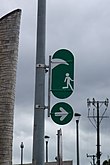 Marking of tsunami evacuation routes is clear and present in all coastal communities.
 Volcano activity warning sign
 Note: Since 2019, there have been violent protests in several major Chilean cities. Exercise caution in large cities. (Information last updated 28 May 2021)
Like most big cities in South America, Santiago suffers from a high rate of pickpocketing and muggings. It's advisable not to travel in the downtown area wearing expensive-looking jewelry or watches, even during the day. Stay alert and be especially careful in all crowded areas in Santiago. It is recommended to wear your backpack at the front of your body in crowded areas. Laptops and the newest mobile phones can be lucrative for thieves, so remember to be on your guard once using them in public places.
For tourists or other "beginners" lacking experience in over-the-counter transactions with hard Chilean currency, you can reduce the chance of your wallet getting stolen by following some advice:
Separate coins and bills. Coins are frequently used when paying for public transport (except in Santiago buses, where you need to board with the Bip card), newspapers or snacks, store them in a small handbag so that your bills will remain concealed. 1000-, 2000- and 5000-peso notes should be easily accessible. Notes of higher value should be stored in another, more secure place in your wallet so you don't accidentally pay 10,000 pesos instead of 1000, for example. All notes have different sizes and they all are very differently colored and designed. Do not reach for your wallet until the vendor tells you the price.Chilean Carabineros (National Police) are trustworthy: call 133 from any phone if you need emergency assistance. Some municipalities (such as Santiago or Las Condes) have private guards; however, they usually don't speak English.
Do not try to bribe a carabinero, since it will get you into serious trouble! Unlike other South American police corps, Chilean Carabineros are very proud and honest, and bribery would be a serious offence against their creed.
Regarding driving conditions: Chilean drivers tend to be not as erratic and volatile as those in neighboring countries.
Some parts of Chile are still racially homogeneous and locals will be curious if they see a person who is either Asian or black. Being of Middle Eastern origin and wanting to blend in amongst Chileans, getting dressed as a local will help you, though naturally, if you speak with a foreign accent, people will pick up on that right away. Cities like Santiago, Viña del Mar or Antofagasta have become more multicultural in the last few years with immigrants from Haiti, Colombia, China, the Dominican Republic and Cuba, so being a foreigner in those places will not be met with curiosity. Some Chileans who have a low opinion of foreigners might yell "negro" (Spanish for black) or "chino" (Spanish for Chinese), but only report to Carabineros if you are physically assaulted by someone. Racist attacks are infrequent in general but the Carabineros know how to deal with such crimes, so don't hesitate to report if something happens.
Immigration from countries where Islam is the state religion is very small compared to countries in Europe. There are mosques in the country, but the average Chilean is not used to seeing a woman in a hijab or burqa, so many will stare or make a comment. There have been reports of verbal harassment by Chileans of women who are dressed traditionally, and some have even reported boys or men dragging them by the hijab. Though this is infrequent, if it happens, report it to the police. Some people will also defend your right to be dressed with a hijab or burqa, so do not assume that all Chileans are Islamophobic. There is a sizeable Palestinian community, but most of them are Christians.
Be careful when taking photos in areas with military buildings or where you see soldiers guarding an entrance for example. They have the right to arrest and confiscate your camera. Be prepared to spend time answering questions and having every single photo examined by a soldier or marine. You will avoid imprisonment due to the fact that marines/ soldiers will understand that you did not understand the warnings being a foreign tourist and interrogation is done because the soldiers are expected to do that when such situation occurs. But it's better to avoid such situation and instead ask if you can take a photo. Some marines or soldiers might speak little English, otherwise point at an object and say "si?", while showing your camera so they understand that you want to take a photo. If they reply with a "no", then it's wise to respect their decision.
Stay out of political protests in any city, especially Santiago. The student protest that shocked the country during 2011 ended with violence. If you want to watch, then stay in a safe area and avoid getting close. The Carabineros are always on the alert as soon as there is a political demonstration and some people join only because they want to cause violence. Also avoid celebrations of sports like Chile winning a tournament for example, since they can end in violence.
If you go out to bars or clubs, be careful when ordering a drink. If you want to be safe, order beer in a bottle or pay for a bottle of wine or hard liquor if possible. Problems with spiked drinks have increased so make sure to always have an eye on your drink when ordering. Places for young people or students tend to have cheap drinks, wine and beer which should be avoided altogether since they are poorly made and can be dangerous for you. Instead, order well known brands like Cristal or Casillero del Diablo in a bar or nightclub.
Walking in the streets in many cities, you will see a lot of stray dogs. They are probably carrying diseases so avoid touching them. They are everywhere and places popular with tourists are full of stray dogs. Don't get involved in an argument if you see local people being aggressive to the stray dogs. They see them every day and will not take kindly to a tourist who has only been in Chile for a couple of days, having an opinion on how to treat the dogs that they feel are aggressive towards the local people. In addition to stray dogs in the cities, in rural areas many places and farms have dogs, but they generally do not tend to leave their premises, which can still happen and they might block your way. In either case, if you feel a dog is getting too close for any reason, even if it looks harmless, pick up one, two or three stones, and most dogs will understand the gesture, back down and disappear into the distance. If this does not help and a dog is running towards you aggressively barking, use the stones for your defence.
Located on the Pacific Ring of Fire, all of Chile is prone to earthquakes and tsunamis.


