

ישראל
IsraelContext of Israel
Israel, officially the State of Israel, is a country in West Asia. It shares borders with Lebanon to the north, Syria to the north-east, Jordan to the east, Egypt to the south-west, and the Mediterranean Sea to the west. It occupies the Palestinian territories of the West Bank in the east and the Gaza Strip in the south-west. Israel also has a small coastline on the Red Sea at its southernmost point, and part of the Dead Sea lies along its eastern border. Its proclaimed capital is Jerusalem, while Tel Aviv is the country's largest urban area and economic center.
Israel is located in the Southern Levant, a region known historically as Canaan, Palestine, or the Holy Land. In antiquity, it was home to the kingdoms of Israel and Judah and Hasmonean Judea, and is refe...Read more
Israel, officially the State of Israel, is a country in West Asia. It shares borders with Lebanon to the north, Syria to the north-east, Jordan to the east, Egypt to the south-west, and the Mediterranean Sea to the west. It occupies the Palestinian territories of the West Bank in the east and the Gaza Strip in the south-west. Israel also has a small coastline on the Red Sea at its southernmost point, and part of the Dead Sea lies along its eastern border. Its proclaimed capital is Jerusalem, while Tel Aviv is the country's largest urban area and economic center.
Israel is located in the Southern Levant, a region known historically as Canaan, Palestine, or the Holy Land. In antiquity, it was home to the kingdoms of Israel and Judah and Hasmonean Judea, and is referred to as the Land of Israel in Jewish tradition. Over the ages, the region was under the rule of empires from the Romans to the Ottomans. The late 19th century saw the rise of Zionism, a movement advocating for the establishment of a Jewish homeland in Palestine and gained British support. After World War I, Britain occupied the region and established Mandatory Palestine in 1920. Increased Jewish immigration in the leadup to the Holocaust and British colonial policy led to intercommunal conflict between Jews and the Arab majority population, which escalated into a civil war in 1947 after the United Nations (UN) proposed partitioning the land between them.
After the end of the British Mandate for Palestine, Israel declared independence on 14 May 1948. Neighboring Arab states invaded the area the next day, beginning the First Arab–Israeli War. An armistice in 1949 left Israel in control of more territory than the U.N. partition plan had called for; and no new independent Arab state was created as the rest of the former Mandate territory was held by Egypt and Jordan, respectively the Gaza Strip and the West Bank. The majority of Palestinian Arabs were either expelled or fled in what is known as the Nakba, with those remaining becoming the new state's main minority. Over the following decades, Israel's population increased greatly as the country received an influx of Jews who emigrated, fled or were expelled from the Arab world. Following the 1967 Six-Day War, Israel occupied the West Bank, Gaza Strip, Egyptian Sinai Peninsula and Syrian Golan Heights. Israel established and continues to expand settlements across the illegally occupied territories, contrary to international law, and has effectively annexed East Jerusalem and the Golan Heights in moves largely unrecognised internationally. After the 1973 Yom Kippur War, Israel signed peace treaties with Egypt—returning the Sinai in 1982—and Jordan. In 1993, Israel signed the Oslo Accords, which established mutual recognition and limited Palestinian self-governance in parts of the West Bank and Gaza. In the 2020s, it normalised relations with several more Arab countries via the Abraham Accords. However, efforts to resolve the Israeli–Palestinian conflict after the interim Oslo Accords have not succeeded, and the country has engaged in several wars and clashes with Palestinian militant groups.
Israel's practices in its occupation of the Palestinian territories have drawn sustained international criticism—along with accusations that it has committed war crimes, crimes against humanity, and genocide against the Palestinian people—from human rights organisations and United Nations officials. The country's Basic Laws establish a parliament elected by proportional representation, the Knesset, which determines the makeup of the government headed by the prime minister and elects the figurehead president. Israel has one of the largest economies in the Middle East, and one of the highest standards of living in Asia. One of the most technologically advanced and developed countries in the world, it spends proportionally more on research and development than any other country in the world and is widely believed to possess nuclear weapons. It has on of the largest economies in the Middle East and theworld's 25th-largest economy by nominal GDP and 16th by nominal GDP per capita.
More about Israel
- Currency Israeli new shekel
- Native name ישראל
- Calling code +972
- Internet domain .il
- Mains voltage 230V/50Hz
- Democracy index 7.84
- Population 9840000
- Area 20770
- Driving side right
- Stay safe
Emergency phone numbers:
Police (mish-ta-RA) — 100 Ambulance Service ("Magen David Adom"-MADA, literally "Red Star of David") — 101 Fire department (me-kha-BEY ESH) — 102Particularly when there is no fighting on the Lebanese or Gaza Strip borders, travel to Israel is quite safe, and crime rates are well below those found in most other Western countries. Having said this, buses and bus stops have been targeted by Palestinian terrorists since the early 1990s, though this became unusual after construction of the West Bank security barrier was initiated in 2005. Some Palestinians have deliberately driven cars or other vehicles into crowds waiting for the Jerusalem Light Rail, for example. However, statistically, the chances of being involved in a traffic accident are much higher than the chances of being involved in an attack.
It is still a good idea to stay informed of developments before and during your stay. Caution should be used particularly in the West Bank, East Jerusalem, and areas surrounding the Gaza Strip (particularly the cities of Sderot and Ashkelon, which have been targeted by rockets from the Strip). If you see anyone acting suspiciously, or find an unattended parcel, notify the police. Also, never leave a bag unattended in a public area, as it may be suspected as a bomb.
Police in Israel wear light blue or very dark navy clothing with flat caps, while Israeli Border Police (similar in function to Gendarmerie) wear dark grey uniforms with green berets or police ball caps. It is not unusual to see plenty of soldiers (and sometimes civilians) carrying firearms (military rifles and handguns) in public. Most of these soldiers are simply on leave from their base. Soldiers have no authority over civilians, except in specially designated zones near borders or military bases, where they are allowed to detain you until the arrival of a police officer.
In terms of typical crime, Israel is a very safe country with one of the lowest crime rates in the world. You can walk around the cities and towns at night without fear, as mugging and drunken violence are rare. Single women should still take care late at night, but the risks here are far lower than practically anywhere in Europe and America.
It is very common (even required by law) to see private armed security guards at every public doorway (for malls, stores, restaurants, etc.). The guards ask to look in your bags and may use a metal-detector on your body. When entering underground parking lots, the trunk of your car will be inspected. Do not be alarmed: this is just national policy. If you carry a huge backpack, you can often get away with showing a passport, and the guards will be just as relieved as you.
...Read moreStay safeRead lessEmergency phone numbers:
Police (mish-ta-RA) — 100 Ambulance Service ("Magen David Adom"-MADA, literally "Red Star of David") — 101 Fire department (me-kha-BEY ESH) — 102Particularly when there is no fighting on the Lebanese or Gaza Strip borders, travel to Israel is quite safe, and crime rates are well below those found in most other Western countries. Having said this, buses and bus stops have been targeted by Palestinian terrorists since the early 1990s, though this became unusual after construction of the West Bank security barrier was initiated in 2005. Some Palestinians have deliberately driven cars or other vehicles into crowds waiting for the Jerusalem Light Rail, for example. However, statistically, the chances of being involved in a traffic accident are much higher than the chances of being involved in an attack.
It is still a good idea to stay informed of developments before and during your stay. Caution should be used particularly in the West Bank, East Jerusalem, and areas surrounding the Gaza Strip (particularly the cities of Sderot and Ashkelon, which have been targeted by rockets from the Strip). If you see anyone acting suspiciously, or find an unattended parcel, notify the police. Also, never leave a bag unattended in a public area, as it may be suspected as a bomb.
Police in Israel wear light blue or very dark navy clothing with flat caps, while Israeli Border Police (similar in function to Gendarmerie) wear dark grey uniforms with green berets or police ball caps. It is not unusual to see plenty of soldiers (and sometimes civilians) carrying firearms (military rifles and handguns) in public. Most of these soldiers are simply on leave from their base. Soldiers have no authority over civilians, except in specially designated zones near borders or military bases, where they are allowed to detain you until the arrival of a police officer.
In terms of typical crime, Israel is a very safe country with one of the lowest crime rates in the world. You can walk around the cities and towns at night without fear, as mugging and drunken violence are rare. Single women should still take care late at night, but the risks here are far lower than practically anywhere in Europe and America.
It is very common (even required by law) to see private armed security guards at every public doorway (for malls, stores, restaurants, etc.). The guards ask to look in your bags and may use a metal-detector on your body. When entering underground parking lots, the trunk of your car will be inspected. Do not be alarmed: this is just national policy. If you carry a huge backpack, you can often get away with showing a passport, and the guards will be just as relieved as you.
Israel's relations with its neighbors should always be something that a traveler should be familiar with, as evidenced by the Israeli–Lebanese conflict of 2006. Despite the current ceasefire there remains a low danger that the conflict will again erupt. Israel has stable relations with both Egypt and Jordan, with which Israel signed peace treaties in 1979 and 1994 respectively. The frontier between the Israeli-ruled part of the Golan Heights and Syria has also generally been quiet since 1974, but there have been attempts by Hezbollah to place missile batteries in the Syrian-controlled part of the Golan Heights, and some stray rockets from the Syrian civil war have hit the Israeli-controlled part of the Golan Heights.
Fighting and hostilities resumed in mid-2014 between Israel and Hamas Palestinian terrorists in the Gaza Strip, affirming that all travel to the Gaza Strip area should be avoided, and in the past several noted foreigners (even volunteers) have been kidnapped by armed militants during escalations. Israel does not allow travel to the Strip; the only way in is via Egypt. And even then, Egypt keeps the border shut most of the time. You might have better luck if you're a journalist, though.
Because of the Israeli-Palestinian conflict and Muslim-Jewish disputes over the status of the Temple Mount/Haram el-Sharif, violent clashes can sometimes break out in and around that holy place, and that these often include stones being thrown at Jewish worshippers at the Western Wall below. Check on current conditions before going to that part of the Old City of Jerusalem.
Hiking trails in southern Israel (and in the Golan) are adjacent to military fire practice areas. If you are not certain where you are going, do not hike in this region. These firing areas are marked on the official hiking maps.
On a similar note, especially near border areas, hiking or leaving the roadways, be aware of standing and/or fallen fences with a sign (yellow with a red triangle on it). These areas are considered off limits due to the possibility of land mines being present. It could take another 100 years to clear out all those areas. Also refer to War zone safety article for more information.
If it's raining or there's a possibility of rain in the area, do not hike in or near rivers or in the desert. Flash floods are common and dangerous. They are very sudden. If you're hiking in a river bed or in a low area and it starts raining, immediately seek higher ground. Stay away from river banks next to fast moving waters as they tend to collapse unexpectedly.
Rocket attacksA rising-and-falling siren alarm is activated after detecting that rockets have been fired towards Israel. Israel's "Iron Dome" launches missiles to intercept incoming rockets, but only when they are headed toward populated areas. Also, it is not 100% effective, and even when it registers a "hit" it creates shrapnel which eventually reaches the ground. As a general rule, the closer you are to the Gaza Strip the less time you have following the siren. If you are in a town bordering Gaza, for example, you only have fifteen seconds before the rocket lands.
You can also download an app onto your phone that will send you an alert: Tzofar-Red Alert and Red Alert:Israel are both great choices.
When an alarm sounds, you must take cover in a shelter. About half of all buildings in Israel have one, and there are public shelters available in many common areas within Israeli cities. If you are in public, look for where other people go. If you are in a building, be sure to note where your nearest shelter is.
If there is no nearby shelter, head for a building, and place yourself as far as you can from windows, or other fragile objects near the windows. If no building is nearby, lie down on your belly and put your hands on your head.
Make sure to check the calendar for memorial days, when a commemoration siren is heard on 10:00 for 2 minutes during Holocaust Remembrance Day, and on Yom-Hazikaron on 20:00 for one minute and on 11:00 for two more minutes. Commemoration sirens don't rise and fall. In general, behave the way others around you do.
The most powerful rockets launched from the Strip are capable of hitting nearly anywhere in the country, but most of the rockets impact within a radius between Ashkelon in the west, Jerusalem in the east, Beersheba in the south, and Tel Aviv in the north. If you are within this area, be alert. Even if you are outside of this radius be vigilant, as rockets from Gaza have hit Haifa, the Negev desert, and even the West Bank in the past.
Gay and lesbian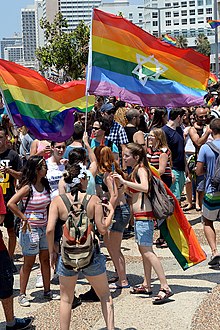 Tel Aviv Gay Pride Parade 2014
Unlike many parts of the Middle East, homosexuality is legal in Israel. In fact, some gay rights advances happened in Israel earlier than in Western countries such as the US. Attitudes towards homosexuality will vary depending on where you go, but in general, Israel is considered safe for gays and lesbians, as violence is rare and open disapproval is mostly confined to certain parts of Jerusalem and/or religious neighborhoods.
All 3 major cities (Jerusalem, Tel Aviv and Haifa) have an annual "Pride" parade, and the annual Love Parade in Tel Aviv gets cheering spectators too. Though Jerusalem has an annual pride parade, it is not very common to see openly gay people in Jerusalem, and you should avoid openly showing your sexual orientation in most public places in Jerusalem or other visibly religious places. In general just try to avoid public displays of homosexual affection or conversation in a direct or suggestive manner in Jerusalem. While anything serious is unlikely to happen to you, it will draw stares and identify you as a "tourist" at the very least.
On the other hand, Tel Aviv is very liberal and gay friendly. It is common to see same-sex couples show affection in public areas. Tel Aviv was declared as the world's best gay travel destination for 2012 in a survey carried out by American Airlines and GayCities.com for good reason: there are many gay friendly places around the city, considered a stronghold of the gay community in Israel. Tel Aviv's nights are full of hundreds of passionate, energetic pubs, bars and dance clubs that are open till dawn. The city is active in all areas of entertainment, and is highly recommended for tourists looking for exciting nightlife in general, and exciting gay nightlife in particular. There is a reason for the old adage "Jerusalem prays, Haifa works and Tel Aviv dances" after all.


