
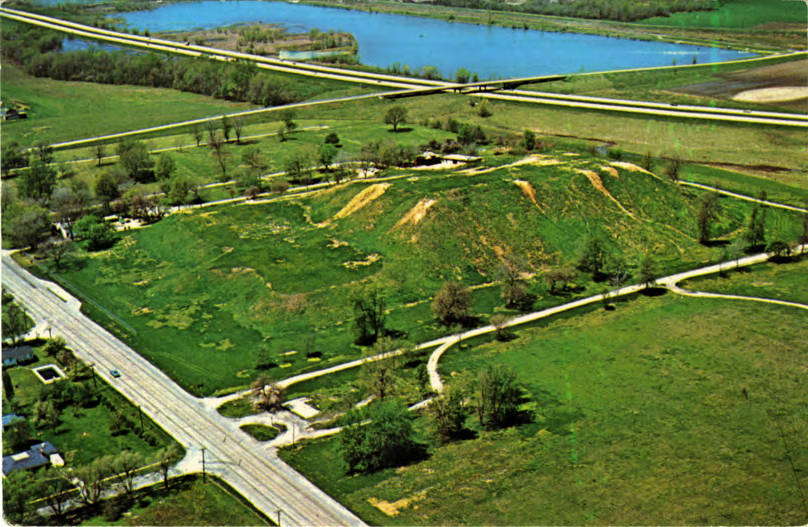
Cahokia Mounds (11 MS 2) is the site of a Native American city (which existed c. 1050–1350 CE) directly across the Mississippi River from present-day St. Louis. The state archaeology park lies in south-western Illinois between East St. Louis and Collinsville. The park covers 2,200 acres (890 ha), or about 3.5 square miles (9 km2), and contains about 80 manmade mounds, but the ancient city was much larger. At its apex around 1100 CE, the city covered about 6 square miles (16 km2), included about 120 earthworks in a wide range of sizes, shapes, and functions, and had a population of between 15,000 and 20,000 people.
Cahokia was the largest and most influential urban settlement of the Mississippian culture, which developed advanced societies across much of what is now the Central and the Southeastern United States, beginning around 1000 CE. Today, the Cahokia Mounds are consider...Read more
Cahokia Mounds (11 MS 2) is the site of a Native American city (which existed c. 1050–1350 CE) directly across the Mississippi River from present-day St. Louis. The state archaeology park lies in south-western Illinois between East St. Louis and Collinsville. The park covers 2,200 acres (890 ha), or about 3.5 square miles (9 km2), and contains about 80 manmade mounds, but the ancient city was much larger. At its apex around 1100 CE, the city covered about 6 square miles (16 km2), included about 120 earthworks in a wide range of sizes, shapes, and functions, and had a population of between 15,000 and 20,000 people.
Cahokia was the largest and most influential urban settlement of the Mississippian culture, which developed advanced societies across much of what is now the Central and the Southeastern United States, beginning around 1000 CE. Today, the Cahokia Mounds are considered to be the largest and most complex archaeological site north of the great pre-Columbian cities in Mexico.
The city's original name is unknown. The mounds were later named after the Cahokia tribe, a historic Illiniwek people living in the area when the first French explorers arrived in the 17th century. As this was centuries after Cahokia was abandoned by its original inhabitants, the Cahokia tribe was not necessarily descended from the earlier Mississippian-era people. Most likely, multiple indigenous ethnic groups settled in the Cahokia Mounds area during the time of the city's apex.
Cahokia Mounds is a National Historic Landmark and a designated site for state protection. It is also one of the 26 UNESCO World Heritage Sites within the United States. The largest pre-Columbian earthen construction in the Americas north of Mexico, the site is open to the public and administered by the Illinois Historic Preservation Division and supported by the Cahokia Mounds Museum Society. In celebration of the 2018 Illinois state bicentennial, the Cahokia Mounds were selected as one of the Illinois 200 Great Places by the American Institute of Architects Illinois component (AIA Illinois). It was recognized by USA Today Travel magazine, as one of the selections for 'Illinois 25 Must See Places'.


![[node:title]](/sites/default/files/styles/640x320/public/default_images/default_0.JPG.webp?itok=aqV9zhFR)




Add new comment