

Italia
ItalyContext of Italy
Italy, officially the Italian Republic, is a country in Southern and Western Europe. It consists of a peninsula that extends into the Mediterranean Sea, with the Alps on its northern land border, as well as nearly 800 islands, notably Sicily and Sardinia. Italy shares land borders with France to the west; Switzerland and Austria to the north; Slovenia to the east; and the two enclaves of Vatican City and San Marino. It is the tenth-largest country in Europe by area, covering 301,340 km2 (116,350 sq mi), and the third-most populous member state of the European Union, with nearly 59 million inhabitants. Italy's capital and largest city is Rome; other major cities include Milan, Naples, Turin, Palermo, Bologna, Florence, Genoa, and Venice.
The history of Italy goes back to numerous Italic peoples—notably including the ancient Romans, who conquered the Mediterranean world during the Roman Republic and ruled it for centurie...Read more
Italy, officially the Italian Republic, is a country in Southern and Western Europe. It consists of a peninsula that extends into the Mediterranean Sea, with the Alps on its northern land border, as well as nearly 800 islands, notably Sicily and Sardinia. Italy shares land borders with France to the west; Switzerland and Austria to the north; Slovenia to the east; and the two enclaves of Vatican City and San Marino. It is the tenth-largest country in Europe by area, covering 301,340 km2 (116,350 sq mi), and the third-most populous member state of the European Union, with nearly 59 million inhabitants. Italy's capital and largest city is Rome; other major cities include Milan, Naples, Turin, Palermo, Bologna, Florence, Genoa, and Venice.
The history of Italy goes back to numerous Italic peoples—notably including the ancient Romans, who conquered the Mediterranean world during the Roman Republic and ruled it for centuries during the Roman Empire. With the spread of Christianity, Rome became the seat of the Catholic Church and the Papacy. Barbarian invasions and other factors led to the decline and fall of the Western Roman Empire between late antiquity and the Early Middle Ages. By the 11th century, Italian city-states and maritime republics expanded, bringing renewed prosperity through commerce and laying the groundwork for modern capitalism. The Italian Renaissance flourished during the 15th and 16th centuries and spread to the rest of Europe. Italian explorers discovered new routes to the Far East and the New World, contributing significantly to the Age of Discovery.
After centuries of political and territorial divisions, Italy was almost entirely unified in 1861, following wars of independence and the Expedition of the Thousand, establishing the Kingdom of Italy. From the late 19th to the early 20th century, Italy rapidly industrialised—mainly in the north—and acquired a colonial empire, while the south remained largely impoverished, fueling a large immigrant diaspora to the Americas. From 1915 to 1918, Italy took part in World War I with the Entente against the Central Powers. In 1922, the Italian fascist dictatorship was established. During World War II, Italy was first part of the Axis until its surrender to the Allied powers (1940–1943), then a co-belligerent of the Allies during the Italian resistance and the liberation of Italy (1943–1945). Following the war, the monarchy was replaced by a republic and the country enjoyed a strong recovery.
A developed country with an advanced economy, Italy has the eighth-largest nominal GDP in the world, the second-largest manufacturing sector in Europe, and plays a significant role in regional and—to a lesser extent—global economic, military, cultural, and political affairs. Italy is a founding and leading member of the European Union, and is part of numerous other international organizations and forums. As a cultural superpower, Italy has long been a renowned global centre of art, music, literature, cuisine, fashion, science and technology, and the source of multiple inventions and discoveries. It has the highest number of World Heritage Sites (60) and is the fourth-most visited country in the world.
More about Italy
- Currency Euro
- Native name Italia
- Calling code +39
- Internet domain .it
- Mains voltage 230V/50Hz
- Democracy index 7.74
- Population 58850717
- Area 302068
- Driving side right
- Stay safe
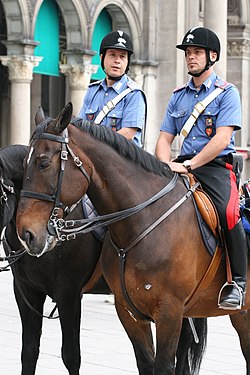 Mounted Carabinieri in Milan.
For emergencies, call 113 (Polizia di Stato - State Police), 112 (Carabinieri - Gendarmerie), 117 (Guardia di Finanza - Financial police force), 115 (Fire Department), 118 (Medical Rescue), 1515 (State Forestry Department), 1530 (Coast Guard), 1528 (Traffic reports).
Italy is a safe country to travel in like most developed countries. There are few incidents of terrorism/serious violence and these episodes have been almost exclusively motivated by internal politics. Almost every major incident is attributed to organised crime or anarchist movements and rarely, if ever, directed at travellers or foreigners.
CrimeViolent crime rates in Italy are low compared to most European countries. If you're reasonably careful and use common sense you won't encounter personal safety risks even in the less affluent neighborhoods of large cities. However, petty crime can be a problem for unwary travellers. Pickpockets often work in pairs or teams, occasionally in conjunction with street vendors; take the usual precautions against pickpockets. Instances of rape and robbery are increasing slightly.
...Read moreStay safeRead less
Mounted Carabinieri in Milan.For emergencies, call 113 (Polizia di Stato - State Police), 112 (Carabinieri - Gendarmerie), 117 (Guardia di Finanza - Financial police force), 115 (Fire Department), 118 (Medical Rescue), 1515 (State Forestry Department), 1530 (Coast Guard), 1528 (Traffic reports).
Italy is a safe country to travel in like most developed countries. There are few incidents of terrorism/serious violence and these episodes have been almost exclusively motivated by internal politics. Almost every major incident is attributed to organised crime or anarchist movements and rarely, if ever, directed at travellers or foreigners.
CrimeViolent crime rates in Italy are low compared to most European countries. If you're reasonably careful and use common sense you won't encounter personal safety risks even in the less affluent neighborhoods of large cities. However, petty crime can be a problem for unwary travellers. Pickpockets often work in pairs or teams, occasionally in conjunction with street vendors; take the usual precautions against pickpockets. Instances of rape and robbery are increasing slightly.
You should exercise the usual caution when going out at night alone, although it remains reasonably safe even for single women to walk alone at night. Italians will often offer to accompany female friends back home for safety, even though crime statistics show that sexual violence against women is rare compared to most other Western countries. In a survey by United Nations, 14% of Italian women had experienced attempted rape and 2.3% had experienced rape in their lifetimes.
The mafia, camorra, and other crime syndicates generally operate in southern Italy and not the whole country, and although infamous are usually not involved in petty crime.
Prostitution is rife in the night streets around cities. Prostitution in Italy is not exactly illegal, though authorities are taking a firmer stance against it than before. Brothels are illegal, though, and pimping is a serious offence, considered by the law similar to slavery. In some areas, it is an offence even to stop your car in front of a prostitute although the rows of prostitutes at the side of many roads, particularly in the suburbs, suggest that the law is not enforced. In general, being the client of a prostitute falls in an area of questionable legality and is inadvisable. Being the client of a prostitute under 18 is a criminal offence. It is estimated that a high percentage of prostitutes working in Italy are victims of human trafficking and modern-day slavery.
There are four types of police forces a tourist might encounter in Italy. The Polizia di Stato (State Police) is the national police force and stationed mostly in the larger towns and cities, and by train stations; they wear blue shirts and grey pants and drive light-blue-painted cars with "POLIZIA" written on the side. The Carabinieri are the national gendarmerie, and are found in the smaller communities, as well as in the cities; they wear very dark blue uniforms with fiery red vertical stripes on their trousers and drive similarly-coloured cars. There is no real distinction between the roles of these two major police forces: both can intervene, investigate, and prosecute in the same way.
The Guardia di Finanza is a police force charged with border controls and fiscal matters; although not a patrolling police force, they sometime aid the other forces in territory control. They dress fully in light grey and drive blue or gray cars with yellow markings. All these police forces are generally professional and trustworthy, corruption being virtually unheard of. Finally, municipalities have local police, with names such as "Polizia municipale" or "Polizia locale" (previously, they were labelled "Vigili urbani"). Their style of dressing varies among the cities, but they will always wear some type of blue uniform with white piping and details, and drive similarly marked cars, which should be easy to spot. These local police forces are not trained for major policing interventions, as in the past they have mostly been treated as traffic police, employed for minor tasks; in the event of major crimes, the Polizia or Carabinieri will be summoned instead.
After leaving a restaurant or other commercial facility, it is possible, though unlikely, that you will be asked to show your bill and your documents to Guardia di Finanza agents. This is perfectly legitimate (they are checking to see if the facility has printed a proper receipt and will thus pay taxes on what was sold).
For all practical matters, including reporting a crime or asking for information, you may ask any police. The Italian Army has also been directly tasked with protecting key locations, including some city landmarks you may want to visit that might be target for terrorist attacks; in case of emergency you can, by all means, ask them for help, but they are not police officers and will have to call the police for you to report a crime and so on.
Police officers in Italy are not authorised to collect fines of any kind and have no authority to ask you for money for any reason (unless you are pulled over in your foreign vehicle and fined, see "Get around/By car" above).
Possession of drugs is always illegal, but it is a criminal offence only above a certain amount.
The main emergency number, handled by the State Police, used to be 113. The medical emergency number is 118, but personnel of the 113 call centre are trained to handle mistakes and will immediately hook you up with actual medical emergency services. Some regions (e.g. Lombardy) have adopted or are adopting the common European emergency number 112.
There are many bars in Italy that cater to tourists and foreigners with "home country" themes, calling themselves such things as "American bars" or "Irish pubs". In addition to travellers, these bars attract a large number of Italians who, among other reasons, go there specifically to meet travellers and other foreigners. While the motivation for the vast majority of these Italians is simply to have a good time with new friends, there may be one or two petty criminals who loiter in and out of these establishments hoping to take advantage of travellers who are disoriented or drunk. Travelling to these places in groups is a simple solution to this problem. Alternatively, if you are alone, avoid getting drunk!
When entering with a car into a city, avoid restricted, pedestrian-only areas (ZTL) or you could be fined about €100.
As in other countries, there are gangs known for tampering with ATMs by placing "skimmers" in front of the card slot and get a clone of your card. Check the machine carefully and, if unsure, use a different one.
Naples and Rome are the cities with the highest rates of crime towards tourists. These two cities are riddled with beggars and criminals and special care must be taken especially near such locations as the main historical monuments (the Colosseum for example) and the popular gathering places for tourists (Campo de' Fiori Square in Rome for example). It must be stated also that every train station in the country attracts lowlifes, and in general train stations, at night, are not places where one might want to linger too long.
Tourist scamsRead up on the legends concerning tourist scams. Most of them occur regularly in bigger cities such as Rome, Milan, or Naples.
Around popular tourist sites, there are people trying to sell cheap souvenirs. They may also carry roses and say they are giving you a gift because they like you but the minute you take their 'gift' they demand money. They are very insistent, pleading and pesty and often the only way to get rid of them is to be plain rude. Do the best you can to not take their "gifts" as they will follow you around asking for money. Simply saying "no" or "vai via" ("go away") will get them off your back until the next vendor comes up to you.
Another typical encounter throughout tourist spots is the fake 'deaf and dumbs' who enter restaurants or bars, leaving small objects (lighters, keychains, or small toys) on tables with a note asking for financial help. Do not examine their wares; leave them down and they will come back and collect it then leave.
A particular scam is when some plainclothes police will approach you, asking to look for "drug money" or to see your passport. This is a scam to take your money. You can scare them by asking for their ID. Guardia di Finanza (the grey uniformed ones) do customs work.
Another scam involves men approaching you, asking where you are from, and beginning to tie bracelets around your wrists. When they are done they will try to charge you upwards of €20 for each bracelet. If anyone makes any attempt to reach for your hand, retract quickly. If you get trapped, you can refuse to pay, but this may not be wise if there are not many people around. Carry small bills or just change, in your wallet, so if you find yourself cornered to pay for the bracelet, you can convince them that €1 or €2 is all you have.
Yet another scam involves being approached by a man, asking you to help break a large bill - usually €20 or €50. Do not give him your money. The bill he is giving you is fake, but at first glance it might seem real.
The best advice to avoid scams is to get away from anyone you have never seen before who starts talking to you.
When taking a taxi, be sure to remember the license number written on the car door. In seconds, people have had a taxi bill increased by €10 or even more.
RacismRacially-motivated violence is rare but it does make the news a few times a year.
Italians may assume a person with prominent "foreign" features to be an immigrant and, regrettably, treat them with some measure of contempt or condescension.
Tourists can generally expect not to be insulted to their face, but unfortunately casual racism and bigotry is not absent from conversation (especially bar talk, and especially if sports games featuring non-white players are on).
Sports-induced attacks (hooliganism) on foreigners are not unknown, and supporters of foreign teams playing in Italy should exercise extra care not to wear their colours openly on the day of the game, outside of the sports ground.
Road safetyDriving in Italy is fast-paced and widely considered to be wild, especially when compared to other European countries. Drivers tend to change lanes quickly and tend to make hasty, irrational driving decisions. It's common for drivers to drive on the wrong side of the roads just to beat the traffic and get ahead of everyone else.
As a pedestrian, be careful when crossing roads, as not all vehicles will stop at marked crossings.