

London
Context of London
London is the capital and largest city of both England and the United Kingdom, with a population of 8,866,180 in 2022. Its wider metropolitan area is the largest in Western Europe, with a population of 14.9 million. London stands on the River Thames in southeast England, at the head of a 50-mile (80 km) tidal estuary down to the North Sea, and has been a major settlement for nearly 2,000 years. Its ancient core and financial centre, the City of London, was founded by the Romans as Londinium and has retained its medieval boundaries. The City of Westminster, to the west of the City of London, has been the centuries-long host of the national government and parliament. London grew rapidly in the 19th century, becoming the world's largest city at the time. Since the 19th century the name "London" has referred to the metropolis around the City of London, historically split between the counties of Middlesex, Essex, Surrey, Kent and Hertfordshire, wh...Read more
London is the capital and largest city of both England and the United Kingdom, with a population of 8,866,180 in 2022. Its wider metropolitan area is the largest in Western Europe, with a population of 14.9 million. London stands on the River Thames in southeast England, at the head of a 50-mile (80 km) tidal estuary down to the North Sea, and has been a major settlement for nearly 2,000 years. Its ancient core and financial centre, the City of London, was founded by the Romans as Londinium and has retained its medieval boundaries. The City of Westminster, to the west of the City of London, has been the centuries-long host of the national government and parliament. London grew rapidly in the 19th century, becoming the world's largest city at the time. Since the 19th century the name "London" has referred to the metropolis around the City of London, historically split between the counties of Middlesex, Essex, Surrey, Kent and Hertfordshire, which since 1965 has largely comprised the administrative area of Greater London, governed by 33 local authorities and the Greater London Authority.
As one of the world's major global cities, London exerts a strong influence on world art, entertainment, fashion, commerce, finance, education, healthcare, media, science, technology, tourism, transport and communications. London is Europe’s most economically powerful city, and is one of the world's major financial centres. London hosts Europe's largest concentration of higher education institutions, comprising over 50 universities and colleges and enrolling more than 500,000 students as of 2023. It is home to several of the world's leading academic institutions: Imperial College London, internationally recognised for its excellence in natural and applied sciences, and University College London (UCL), a comprehensive research-intensive university, consistently rank among the top ten globally. Other notable institutions include King's College London (KCL), highly regarded in law, humanities, and health sciences; the London School of Economics (LSE), globally prominent in social sciences and economics; and specialised institutions such as the Royal College of Art (RCA), Royal Academy of Music (RAM), the Royal Academy of Dramatic Art (RADA), the School of Oriental and African Studies (SOAS) and London Business School (LBS). It is the most-visited city in Europe and has the world's busiest city airport system. The London Underground is the world's oldest rapid transit system.
London's diverse cultures encompass over 300 languages. The 2023 population of Greater London of just under 10 million made it Europe's third-most populous city, accounting for 13.4 per cent of the United Kingdom's population and over 16 per cent of England's population. The Greater London Built-up Area is the fourth-most populous in Europe, with about 9.8 million inhabitants as of 2011. The London metropolitan area is the third-most-populous in Europe, with about 14 million inhabitants as of 2016, making London a megacity.
Four World Heritage Sites are located in London: Kew Gardens; the Tower of London; the site featuring the Palace of Westminster, Church of St. Margaret, and Westminster Abbey; and the historic settlement in Greenwich where the Royal Observatory defines the prime meridian (0° longitude) and Greenwich Mean Time. Other landmarks include Buckingham Palace, the London Eye, Piccadilly Circus, St Paul's Cathedral, Tower Bridge and Trafalgar Square. The city has the most museums, art galleries, libraries, and cultural venues in the UK, including the British Museum, the National Gallery, the Natural History Museum, Tate Modern, the British Library and numerous West End theatres. Important sporting events held in London include the FA Cup Final, the Wimbledon Tennis Championships and the London Marathon. It became the first city to host three Summer Olympic Games upon hosting the 2012 Summer Olympics.
More about London
- Population 8799728
- Area 1572
- Stay safe
In an emergency, telephone "999" (or "112"). This number connects to Police, Ambulance and Fire/Rescue services. You will be asked which of these three services you require before being connected to the relevant operator.
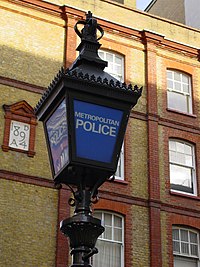 A Traditional 'Blue Lamp' outside a Police Station in London
London has one of the oldest police forces in the world, The Metropolitan Police Service, and on the whole, London is a safe place to visit and explore. Alongside the regular Police, there are over 4,000 Police Community Support Officers (PCSOs) that provide a highly visible presence on the streets and can deal with low-level crime. Normal precautions for the safe keeping of your personal possessions, as you would in any other city, are suggested.
CrimeLike many big cities, London has a variety of social problems, especially begging, drug abuse and theft (mobile phones are a favourite, often snatched by fast-moving moped riders).
...Read moreStay safeRead lessIn an emergency, telephone "999" (or "112"). This number connects to Police, Ambulance and Fire/Rescue services. You will be asked which of these three services you require before being connected to the relevant operator.
A Traditional 'Blue Lamp' outside a Police Station in LondonLondon has one of the oldest police forces in the world, The Metropolitan Police Service, and on the whole, London is a safe place to visit and explore. Alongside the regular Police, there are over 4,000 Police Community Support Officers (PCSOs) that provide a highly visible presence on the streets and can deal with low-level crime. Normal precautions for the safe keeping of your personal possessions, as you would in any other city, are suggested.
CrimeLike many big cities, London has a variety of social problems, especially begging, drug abuse and theft (mobile phones are a favourite, often snatched by fast-moving moped riders).
The Metropolitan Police have placed significant resources in combating street level crime. Working in conjunction with borough councils, they have brought the level of theft and pickpocketing in major retail areas in London to a manageable level. Pickpocketing in London is not as rampant as in other major European cities, though it still pays to be vigilant and take the usual precautions in securing your valuables.
Street gang culture is a growing problem in London as with many other cities in England. While most groups of youngsters are not likely to present any danger to tourists, some people feel the need to be slightly more vigilant in certain areas, especially certain outer suburbs. Violent crime is in general not common, and typically occurs in impoverished neighbourhoods that tourists are unlikely to wander into by accident.
Very broadly speaking, areas with acute crime problems include Tottenham, Croydon, Brixton, Poplar, and Peckham.
Main precautions to take Keep valuables out of sight: Many crimes are opportunistic - a lot of mobile phones are snatched from restaurant tables. By keeping items such as cash and mobile phones out of sight theft can easily be prevented. Don't flash your cash unnecessarily! Keep bags zipped up and close to your body: If your bag is hanging open it's like putting up a flashing neon sign saying "Steal from me!" Use zips and inside pockets to secure items wherever possible. Never leave valuables such as mobile phones, wallets, or travel documents in an outside section of your bag. Be aware of your surroundings: Before using your mobile phone have a look around you. Put your back against something solid such as a wall or window so you can't be approached from behind. If you're in a train or Tube station try to use your phone before leaving as all stations have CCTV. Constantly look around you even if you are in a busy area. Don't walk and talk/text!Late at nightIf you're planning to go out late at night and are worried about safety then try to frequent crowded areas such as the West End. There are always plenty of people on the street, even at 04:00. Generally, outside central London, the south, and east suburban areas are considered more dangerous, notably Brixton, Peckham and Hackney, although some parts of north-west London such as Harlesden and northern Camden are also known trouble spots.
The main problem throughout London to various degrees is drunken behaviour, particularly on Friday and Saturday nights and after football matches. Loud and rowdy behaviour is to be expected and fights and acts of aggression also occur. If you are harassed, it is best to simply ignore and walk away from those concerned. Trouble spots can be expected around popular drinking locations such as Soho and in various suburban centres.
Scams and consLondon has a large number of con artists around, all trying to convince you to hand over your money one way or another. In general, you should never give cash or your bank/credit card detail to people on the street no matter how genuine they seem.
Cash machine/ATM scams: Most usage of these machines is perfectly safe, but there are various ways that thieves can either obtain your card or your cash when using an ATM. It is always safest to withdraw cash using a machine inside a bank, but street machines are usually more convenient. Before inserting your card visually check the machine for anything that looks odd. Thieves sometimes install cameras above the pin pad. If things look OK then reach out and wiggle the slot where you insert your card - if the slot's loose, don't put your card in, as there may be a device installed to trap your card. All good? OK, is there anyone standing too close to you or hovering nearby? If so, perhaps cancel the transaction and go elsewhere. If everything's good then go ahead! When obtaining your cash and retrieving your card hover your hand over the slot to be ready to grab them as soon as they come out. Is anyone trying to distract you? Don't let them and leave swiftly. If you notice anything odd about a cash machine or people nearby then phone the police on 101 (999 in an emergency) or report it to the premises the machine is attached to. Don't try to remove any devices yourself.
Cup and ball game: This variant of a scam dating back into antiquity is perhaps the most common and is frequently seen on the busier pedestrian bridges such as Westminster Bridge. A person will lay out a mat with three cups on it. They will pretend to hide a ball under one of the cups, move the cups around, and then ask you to place a bet on where the ball-containing cup has landed. There is no ball - the con artist will have spirited it away! This con always has people acting as lookouts in the crowd and they will pretend to win every now and again so it looks like the game is winnable. Also beware if you are just stopping to watch as you could be pick-pocketed! The best defence is to walk straight past these events and not engage at all. If you have a mobile phone/cellphone that works in the UK you can phone the police on 101 (the non-emergency equivalent to 999) and report them, but it is advised to move away to do this as you may be harassed by the con artist or their lookouts if they overhear you.
Overzealous street performers: Most street performers are happy to just do their thing, let you watch, and then you can throw them a few coins if you liked the show. However, some street performers will actively grab and harass passers-by in order to get attention and money. They may forcefully pose with you and ask you to take a photograph and then demand money for the photo opportunity. They may also take this opportunity while you're distracted to pick-pocket you. Don't engage with any street performer who is pushy or forceful - try and walk away, or call out "Get off me!" or "No!" and draw attention to yourself if you can't escape easily. Again, you can report these bogus street performers on the 101 number as above.
Tissue sellers on trains: Beggars will get onto a train and place tissues on the seats with a note begging for money. They want you to feel pity for them and buy the tissues, but this is an organised scam and the money goes towards criminal enterprises. If you see this happening on a train don't buy the tissues and ignore anyone who asks you for money for them. If you're above ground you can text the British Transport Police on 61016 to report it.
"Clip joint": Every night, Soho presents a particular danger: the "clip joint". The usual targets of these establishments are lone male tourists. Usually, an attractive woman will casually befriend the victim and recommend a local bar or even a club that has a "show". The establishment will be near-desolate, and, even if the victim has only a drink or two, the bill will run to hundreds of pounds. If payment is not immediately provided, the bouncers will lock the "patrons" inside and take it by force or take them to an ATM and stand over them while they extract the cash. To be safe, if a woman you just met suggests you a place, try to recommend a different bar. If she insists on hers then walk away and do not listen to her suggestions. Sometimes this con trick takes place when someone is lured into a private club with the promise of something perhaps more than a drink (like a "private show" or sex for a small amount of money). A "hostess fee" will appear on the bill for several hundred pounds, even though there has been nothing more than polite conversation.
"Stress tests": If anyone offers you a free "stress test", they are likely trying to recruit you into the Church of Scientology. The best option is to walk away or just say "No thank you" politely, as people are commonly harassed into giving personal details.
Needing money for phone/train tickets/the bus/et al.: Someone will approach you asking for money for public transport. They will claim that they have lost their Travelcard or that it has been damaged somehow. Most people upon losing their Travelcard will seek aid at a train station and not approach random strangers! Another variant of this scam exists wherein a man or woman will ask for change so they can make a call at a phone box. Occasionally a person with a very convincing fake injury will ask for money so that they can get a taxi to hospital, strangely refusing the offer of you calling an ambulance or the police for them as you would do for most injured people in the street. Ignore them.
Ticket machine scam: One of the most popular scams in London is the ticket machine scam: While buying a ticket at a train station someone will approach you and act as if they want to help you buy the right ticket. In reality, they will wait until your money is in the machine, then lean across, cancel the transaction and pocket your cash. Say "No thanks" politely - you know what ticket you want to buy!
Selling/asking for a donation for "lucky heather": This scam, usually operated by women, involves someone handing you "lucky heather" (a small flower usually wrapped in foil) and then either trying to sell it to you or asking for a monetary donation. They will come up with a vague charity ("money for sick children", "money for orphaned babies", and so on) and show you a purse full of supposed "donations". If you are handed one of these flowers either hand it back or drop it on the ground and leave. Be aware that you if you take the flower and leave without "donating" you could be chased and harassed by the people involved in the scam.
Street collectionsAlthough not illegal, London is a known hotspot for charity collectors, some of whom can be extremely persuasive in trying to obtain a donation; therefore they have earned the name "charity muggers" or "chuggers". If you do not want to donate, be polite but forceful, and under no circumstances provide any form of bank details. Larger charities ask their collectors to have specific and verifiable identification.
TransportDon't take illegal minicabs (see Get around for details). No Minicabs are allowed to ply for trade on the street, and any doing this should be avoided.
Travelling on the lower deck of a night bus is generally safer, as there are more passengers around, and you are visible to the bus driver.
If you have been the victim of crime on the railways or the London Underground you should report the crime as soon as possible to the British Transport Police who have an office in most major train and Tube stations. If you have been a victim of crime in the City of London you should report the crime to the City of London Police. Elsewhere, you should report your crime as normal to the Metropolitan Police.
If you've lost an item on the Underground, Overground or Docklands Light Railway, in a licensed black cab, or on a red London bus then you should contact the TfL Lost Property Office as soon as possible.
If an item is lost or misplaced on other transport services in London, the relevant service operator should be contacted.
Bank, credit and debit cards, when found, are securely destroyed. Contact your bank immediately if you lose these on a transport service.


