
भारत
IndiaContext of India
India, officially the Republic of India, is a country in South Asia. It is the seventh-largest country by area; the most populous country since 2023; and since its independence in 1947, the world's most populous democracy. Bounded by the Indian Ocean on the south, the Arabian Sea on the southwest, and the Bay of Bengal on the southeast, it shares land borders with Pakistan to the west; China, Nepal, and Bhutan to the north; and Bangladesh and Myanmar to the east. In the Indian Ocean, India is near Sri Lanka and the Maldives; its Andaman and Nicobar Islands share a maritime border with Thailand, Myanmar, and Indonesia.
Modern humans arrived on the Indian subcontinent from Africa no later than 55,000 years ago. Their long occupation, predominantly in isolation as hunter-gatherers, has made the region highly diverse. Settled life emerged on the subcontinent in the western margins of the Indus river basin 9,000 years ago, evolving...Read more
India, officially the Republic of India, is a country in South Asia. It is the seventh-largest country by area; the most populous country since 2023; and since its independence in 1947, the world's most populous democracy. Bounded by the Indian Ocean on the south, the Arabian Sea on the southwest, and the Bay of Bengal on the southeast, it shares land borders with Pakistan to the west; China, Nepal, and Bhutan to the north; and Bangladesh and Myanmar to the east. In the Indian Ocean, India is near Sri Lanka and the Maldives; its Andaman and Nicobar Islands share a maritime border with Thailand, Myanmar, and Indonesia.
Modern humans arrived on the Indian subcontinent from Africa no later than 55,000 years ago. Their long occupation, predominantly in isolation as hunter-gatherers, has made the region highly diverse. Settled life emerged on the subcontinent in the western margins of the Indus river basin 9,000 years ago, evolving gradually into the Indus Valley Civilisation of the third millennium BCE. By 1200 BCE, an archaic form of Sanskrit, an Indo-European language, had diffused into India from the northwest. Its hymns recorded the early dawnings of Hinduism in India. India's pre-existing Dravidian languages were supplanted in the northern regions. By 400 BCE, caste had emerged within Hinduism, and Buddhism and Jainism had arisen, proclaiming social orders unlinked to heredity. Early political consolidations gave rise to the loose-knit Maurya and Gupta Empires. Widespread creativity suffused this era, but the status of women declined, and untouchability became an organized belief. In South India, the Middle kingdoms exported Dravidian language scripts and religious cultures to the kingdoms of Southeast Asia.
In the early medieval era, Christianity, Islam, Judaism, and Zoroastrianism became established on India's southern and western coasts. Muslim armies from Central Asia intermittently overran India's northern plains in the second millennium. The resulting Delhi Sultanate drew northern India into the cosmopolitan networks of medieval Islam. In south India, the Vijayanagara Empire created a long-lasting composite Hindu culture. In the Punjab, Sikhism emerged, rejecting institutionalised religion. The Mughal Empire ushered in two centuries of economic expansion and relative peace, leaving a rich architectural legacy. Gradually expanding rule of the British East India Company turned India into a colonial economy but consolidated its sovereignty. British Crown rule began in 1858. The rights promised to Indians were granted slowly, but technological changes were introduced, and modern ideas of education and the public life took root. A nationalist movement emerged in India, the first in the non-European British empire and an influence on other nationalist movements. Noted for nonviolent resistance after 1920, it became the primary factor in ending British rule. In 1947, the British Indian Empire was partitioned into two independent dominions, a Hindu-majority dominion of India and a Muslim-majority dominion of Pakistan. A large-scale loss of life and an unprecedented migration accompanied the partition.
India has been a federal republic since 1950, governed through a democratic parliamentary system. It is a pluralistic, multilingual and multi-ethnic society. India's population grew from 361 million in 1951 to over 1.4 billion in 2023. During this time, its nominal per capita income increased from US$64 annually to US$2,601, and its literacy rate from 16.6% to 74%. A comparatively destitute country in 1951, India has become a fast-growing major economy and hub for information technology services; it has an expanding middle class. Indian movies and music increasingly influence global culture. India has reduced its poverty rate, though at the cost of increasing economic inequality. It is a nuclear-weapon state that ranks high in military expenditure. It has disputes over Kashmir with its neighbours, Pakistan and China, unresolved since the mid-20th century. Among the socio-economic challenges India faces are gender inequality, child malnutrition, and rising levels of air pollution. India's land is megadiverse with four biodiversity hotspots. India's wildlife, which has traditionally been viewed with tolerance in its culture, is supported in protected habitats.
More about India
- Currency Indian rupee
- Native name भारत
- Calling code +91
- Internet domain .in
- Mains voltage 230V/50Hz
- Democracy index 6.61
- Population 1326093247
- Area 3287263
- Driving side left
- Stay safe
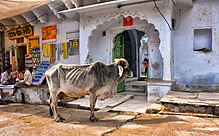 Holy cow in Pushkar
As a rule India is quite safe for foreigners, apart from instances of petty crime and theft common to any developing country, as long as certain basic precautions and common sense are observed (i.e. women should be cautious travelling alone at night). You can check with your embassy or ask for local advice before heading to Jammu and Kashmir and Ladakh in northern-most India, and to Northeast India, i.e. (Assam, Nagaland, Tripura, Mizoram, Meghalaya, Manipur and Arunachal Pradesh). These areas have had serious law and order problems for a long time, though the situation has improved a lot. The same applies while travelling to what used to be a thickly forested area in East-Central India, which covers the states of Chhattisgarh, Jharkhand, the eastern edge of Maharashtra and the northern tip of Telangana. Though the problem is only in the remote areas of these states and normal areas to visit in Chhattisgarh, Jharkhand, Maharashtra or Telangana are safe.
...Read moreStay safeRead less Holy cow in Pushkar
As a rule India is quite safe for foreigners, apart from instances of petty crime and theft common to any developing country, as long as certain basic precautions and common sense are observed (i.e. women should be cautious travelling alone at night). You can check with your embassy or ask for local advice before heading to Jammu and Kashmir and Ladakh in northern-most India, and to Northeast India, i.e. (Assam, Nagaland, Tripura, Mizoram, Meghalaya, Manipur and Arunachal Pradesh). These areas have had serious law and order problems for a long time, though the situation has improved a lot. The same applies while travelling to what used to be a thickly forested area in East-Central India, which covers the states of Chhattisgarh, Jharkhand, the eastern edge of Maharashtra and the northern tip of Telangana. Though the problem is only in the remote areas of these states and normal areas to visit in Chhattisgarh, Jharkhand, Maharashtra or Telangana are safe.
 A beggar in Kolkata
Unfortunately theft is quite common in places visited by tourists, but violent thefts hardly ever occur. More likely a thief will pickpocket or break into your room. Take precautions to firmly lock the door while indoors, and be on guard while outside.
Some people handling your cash will try to shortchange you or rip you off. In Delhi particularly, this is a universal rule adhered to by all who handle westerners' cash. This does not exclude official ticket sellers at tourist sites, employees at prepaid taxi stands, or merchants in all but the most upscale businesses. Count your cash before handing it over, and ensure receiving the correct change.
It is advisable or better to agree on the fare before getting inside an auto or a taxi. This avoids any further unpleasant fare-related arguments. If you can take the advice of a local friend or someone manning your hotel's front desk to know how much it should cost to travel between two destinations, you will be a smart traveller.
Overseas visitors are often magnets for beggars, frauds and touts. Beggars will often go as far as touching you and following you, tugging on your sleeve. It does little good to get angry or to say "No" loudly. The best response is to look unconcerned and ignore the behaviour. The more attention you pay to a beggar or a tout, positive or negative, the longer they will follow you hoping for a donation. Begging is criminalised in cities such as Mumbai and Delhi. It is however common in many cities, and in pilgrim cities, there are sadhus who live an ascetic lifestyle of the seeker that requires them to adopt bhiksha-charya (begging vows) only for sustaining the body.
While hospitality is important in India, it is not common to see people offering to share food or cookies while they eat. Some such offers are genuine and some are not. In case you are travelling by train, you are offered food from a family group, you can take a bite. But if you are offered something by men or even a couple eating a part of it, try avoiding it, as the other part may have sedatives (this may be so that they may loot your belongings when you become unconscious). You can politely say no with a smile; they won't take it personally.
While travelling in public transport (trains, buses) do not accept any food or drink from any local fellow passenger even if they are very friendly or polite. There have been instances in which very friendly fellow passengers offered food or drinks including tea or coffee that contained substances that put the victim to sleep whilst all their possessions, including even their clothing, were stolen.
Visitors should not trust strangers offering assistance or services; see Common scams. Be particularly wary of frauds at tourist attractions such as the temples of Kanchipuram, where they prey on those unfamiliar with local and religious customs. If a priest or guide offers to treat you to a religious ceremony, find out what it will cost you first, and do not allow yourself to be pressured into making "donations" of thousands of rupees — simply walk away if you feel uncomfortable. However, don't get too paranoid: foreigners on the train, or Indian families who want to take your picture on their own camera, for example, are often just genuinely curious.
Same-sex intercourse was decriminalised by a court ruling in 2018. There is a vibrant gay nightlife in metropolitan areas and some (but very few) openly gay celebrities. On the other hand, the law was used as a tool by policemen to harass gays cruising on the streets. You will often see Indian men walking hand-in-hand in the streets, but this is a sign of friendship, not homosexuality.
Whereas Indian men can be really eager to talk to foreigners, women in India often refrain from contact with men. It is an unfortunate fact that if you are a man and you approach a woman in India for even an innocuous purpose like asking for directions, you are putting her on the defensive usually, especially the ones dressed traditionally. It is better to ask a man if one is available (there usually will be), or be extra respectful if you are asking a woman.
Black people may encounter prejudices from the police and the general public about being drug dealers. This reaction stems from the fact that more often than not, foreign-born drug peddlers in India are of Nigerian nationality. Indians find it hard to differentiate between Nigerians and other Africans, others of African descent or even their own Siddi (Indians of sub-Saharan African descent) community, and this behaviour is towards the whole race and not just to any specific country. That said, this behaviour is still considered publicly unacceptable when Indians are confronted by Indians themselves. It is hence wise to keep passports handy at all times, avoid going to areas notorious for illegal activities and maintain contact with respective embassies and, if possible, with other support groups that can vouch for you.
The cow is considered to be a holy animal in Hinduism, and in many Indian states, it is illegal to consume or possess beef or buffalo meat. Non-Hindus suspected of slaughtering cattle or eating beef are also known to have been lynched by fundamentalist Hindu mobs. Prominent exceptions to this taboo are the state of Kerala and the northeastern parts of the country, where the meat of water buffaloes is widely consumed. Beef continues to be rare.
Driving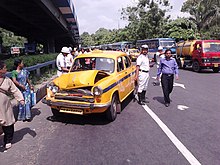 A car crash in Kolkata
As a former British colony, India drives on the left side of the road.
Driving in India can be dangerous. Irresponsible driving habits, insufficient highway infrastructure development, wandering livestock and other hazards make travelling on the country's roads a sometimes nerve-wracking undertaking.
More than 150,000 people died on Indian roads in 2019, the highest figure in the world, and that's despite having only 44 cars per 1,000 people. The first encounter with a typical Indian highway will no doubt feature a traffic mix of lumbering trucks, speeding maniacs, blithely wandering cows and suicidal pedestrians, all weaving across a narrow, potholed strip of tarmac. To minimise your risk of becoming a grim statistic, use trains instead of buses, use government bus services instead of private ones (which are more likely to force their drivers into inhuman shifts), use taxis instead of auto-rickshaws, avoid travelling at night, and don't hesitate to change taxis or cars if you feel your driver is unsafe.
Of significant concern is that much of the road network is significantly underdeveloped. Most roads are very poorly built and they are full of rubble, large cracks and potholes. Most road signs are not very reliable in the country, and in most cases provide drivers with confusing or inaccurate information. If you are in doubt, ask the locals, normally they are very helpful and willingly provide people with appropriate guidance to a location. Of course, the quality of information and willingness to provide it varies, especially in the larger cities.
Female travellers Night in Indore
India is a socially conservative country, and although some Western habits can be perceived as dishonourable for a woman in much of the country, India is coming out of its conservative image rather quickly, especially in big cities. By "conservative", this doesn't mean women are always suppressed because the world's only women-run market, the Ima Market (Manipuri: Ima Keithel) in Imphal, Manipur, is a sign of women empowerment. People usually say "Asia's largest women market" but this 500-year-old market is the "World's only women-run market" and a matter of pride for the whole nation of the world.
White and/or East Asian females may receive some extra attention (usually in the form of stares) from the locals (particularly men) and in some cases, they may even want to take photographs with you. To a large extent, it's likely that the person who wants to take a photo with you or is staring at you has little to no contact with foreigners. This said it's still possible to encounter someone who may harass you. Don't be afraid to create a scene and don't feel the need to be polite; no Indian woman (or any woman for that matter) would put up with rotten behaviour like that. Being overly friendly and appreciative to Indian men is often seen as a sign of romantic interest. If a man and a woman are seen together or talk to each other quite often, locals may assume that there's something going on between the man and the woman. Make it clear that you are friends or acquaintances; that will usually ward people off. Outside of the larger cities, it is unusual for people of the opposite sex to touch each other in public. Even couples (married or otherwise) refrain from public displays of affection. Therefore, it is advised that you do not shake hands with a person of the opposite sex unless the other person extends his/her hand first. The greeting by a Hindu is to bring their palms together in front of their chest, or simply saying namaste or namaskar or namaskaram in most Indic languages (Indo-Aryan and Dravidian) and khurumjari in Meitei (Manipuri). Both forms are equally polite and correct if a little formal. Almost all people (even if they don't know English) do understand a "hi" or a "Hello". In most parts of northern India and cities, it is quite acceptable to offer a "hello" or "good day" followed by a handshake, regardless of gender. Outside of trendy places or high society, women generally do not smoke. In some rural or tribal areas women do smoke, but discreetly. Places such as discos and dance clubs are less conservative areas. It is good to leave your things at a hotel and head down there for a drink and some light conversation. Only carry as much change as you think you would require since losing your wallet or passport means that you will waste a considerable time trying to get help. People are generally modestly clothed even at the beaches, so be sure to find out what the appropriate attire is for the beach you are visiting. In tourist-oriented places like Goa, where beachgoers are predominantly foreigners, it is permissible to wear bikinis on the beach. However, it is still offensive to walk around in them elsewhere. There are a few beaches where women (mostly foreigners) sunbathe topless, but make sure that it is safe and accepted before you do so. It's not so safe to walk in isolated places if you are a solo female. Especially at night, avoid walking on streets or lanes without many people and be cautious when taking a taxi or auto-rickshaw at night. Avoid clothes such as tight shorts, a miniskirt, sports bra, tank-top or other clothes which expose a lot of skin, as they can attract unwanted attention. There have been some rapes of foreign women and highly publicised rapes of Indian women, some of whom have been murdered. India has been characterised as one of the "countries with the lowest per capita rates of rape" but a large number of rapes go unreported. The willingness to report rape has increased after several incidents received widespread media attention and triggered the widespread public protest. The Indian government of India has also reformed its penal code in relation to crimes of rape and sexual assault. In local and suburban trains, there are usually cars reserved only for women and designated as such on their front. In Delhi Metro trains, it is the first compartment. In most buses (private and public) a few seats at the front or at one side of the bus are reserved for women. Usually, these seats will be occupied by men and, very often, they vacate the place when a female stands near gesturing her intention to sit there. In many parts of the country, women will not share a seat with a man other than her spouse. If you sit near a man, he may stand up from the seat and give his seat also to you; this is a sign of respect, not rudeness. Street parties for holidays are usually filled with crowds of inebriated men. During festivals such as Holi, New Year's Eve, and even Christmas Eve, women can be subjected to groping and sexually aggressive behaviour from a certain section hiding in these crowds. In such an event, just scream or make a scene pointing your finger at the person. People will come to your help. It may be less advisable for women to attend these festivities alone. So-called Eve teasing is a common term used in Indian English to refer to anything from unwanted verbal advances to physical sexual assault. Anything overt should be treated in a firm manner and if needed, ask the local populace (women in particular) to try and get the message across. Avoid confrontation if at all possible. Sticking to such an area is not recommended. It's not disrespectful for a woman to tell a man eager to talk to her that she doesn't want to talk: so if a man's behaviour makes you uncomfortable, say so firmly. If he doesn't seem to get the hint, quietly excusing yourself is a better answer than confrontation. Befriending Indian women can be a wonderful experience for female visitors, although you might have to initiate conversation. An easy topic to get things going is to talk about clothes or food. Dressing in traditional Indian clothes, such as salwaar kameez (comfortable) or saree (more formal and difficult to wear) will often garner Western women more respect in the eyes of locals. The idea is to portray yourself as a normal person, instead of a distanced tourist. Easy clothing is to wear a kurta paired up with jeans or a salwar. They are very comfortable and most of the women do the same. Body searches (such as at the airport) by officers of the opposite sex are not allowed in India. Police officers in VaranasiPolice and other emergency services Like other federal countries, law enforcement is dealt with by various agencies in India: General policing is responsible for the states and union territories, under various state and union territory police forces. Large cities like Mumbai or Bangalore may also have their own police departments, often operating independently from state police forces. The Central government also maintain federal law-enforcement agencies responsible for specific duties, such as railway policing, transport security and border patrol. Unfortunately, corruption and inefficiency are present in all Indian police forces, and the quality of the police force varies by officer. For emergencies, throughout most of India, you can dial 100 for police assistance. Try to speak the words slowly so that the police officer on phone does not have a problem in comprehending your foreign English accent. For non-emergency crimes, go down to the police station to report them, and insist on getting a receipt of your complaint. You should insist the police to make a first information report (FIR) and receive a copy of it if you are reporting any serious crimes, as it is a legal requirement for them to do so. The police will only start the investigation after the FIR is made. The emergency contact numbers for most of India are: 100 (Police), 101 (Fire and rescue), and 102 (Emergency medical service). Dialling to neighbouring major hospitals may also work in case of medical emergencies. In Chennai, Hyderabad, Ahmedabad, Bangalore, Kochi and several other cities throughout India, you can dial 108 for all emergencies.Terrorism
The India-Pakistan conflict, simmering for decades, has manifested in terrorist attacks on India's main cities: since 2007, there have been bombings in Delhi, Mumbai and other big cities. The targets have varied widely, but attacks have usually been aimed at locals rather than visitors. The exception was in 2008, when a shooting spree targeted and killed many foreigners along with Indians, in Mumbai's posh hotels and railway station, etc. All the terrorists involved in this were from Pakistan and were killed in action except one who was captured alive and later hanged. There is little you can do to avoid such random attacks, but keep an eye on the national news and any travel advisories from your embassy.