
Iceland
Context of Iceland
Iceland is a Nordic island country between the North Atlantic and Arctic Oceans, on the Mid-Atlantic Ridge between North America and Europe. It is culturally and politically linked with Europe and is the region's westernmost and most sparsely populated country. Its capital and largest city is Reykjavík, which is home to about 36% of the country's roughly 380,000 residents (excluding nearby towns/suburbs, which are separate municipalities). The official language of the country is Icelandic. Iceland is on a rift between tectonic plates, and its geologic activity includes geysers and frequent volcanic eruptions. The interior consists of a volcanic plateau with sand and lava fields, mountains and glaciers, and many glacial rivers flow to the sea through the lowlands. Iceland is warmed by the Gulf Stream and has a temperate climate, despite being a latitude just south of the Arctic Circle. Its latitude and marine influence keep summers chilly, and m...Read more
Iceland is a Nordic island country between the North Atlantic and Arctic Oceans, on the Mid-Atlantic Ridge between North America and Europe. It is culturally and politically linked with Europe and is the region's westernmost and most sparsely populated country. Its capital and largest city is Reykjavík, which is home to about 36% of the country's roughly 380,000 residents (excluding nearby towns/suburbs, which are separate municipalities). The official language of the country is Icelandic. Iceland is on a rift between tectonic plates, and its geologic activity includes geysers and frequent volcanic eruptions. The interior consists of a volcanic plateau with sand and lava fields, mountains and glaciers, and many glacial rivers flow to the sea through the lowlands. Iceland is warmed by the Gulf Stream and has a temperate climate, despite being a latitude just south of the Arctic Circle. Its latitude and marine influence keep summers chilly, and most of its islands have a polar climate.
According to the ancient manuscript Landnámabók, the settlement of Iceland began in 874 AD, when the Norwegian chieftain Ingólfr Arnarson became the island's first permanent settler. In the following centuries, Norwegians, and to a lesser extent other Scandinavians, immigrated to Iceland, bringing with them thralls (i.e., slaves or serfs) of Gaelic origin. The island was governed as an independent commonwealth under the native parliament, the Althing, one of the world's oldest functioning legislative assemblies. After a period of civil strife, Iceland acceded to Norwegian rule in the 13th century. In 1397, Iceland followed Norway's integration into the Kalmar Union along with the kingdoms of Denmark and Sweden, coming under de facto Danish rule upon its dissolution in 1523. The Danish kingdom introduced Lutheranism by force in 1550, and the Treaty of Kiel formally ceded Iceland to Denmark in 1814.
Influenced by ideals of nationalism after the French Revolution, Iceland's struggle for independence took form and culminated in the Danish–Icelandic Act of Union in 1918, with the establishment of the Kingdom of Iceland, sharing through a personal union the incumbent monarch of Denmark. During the occupation of Denmark in World War II, Iceland voted overwhelmingly to become a republic in 1944, ending the remaining formal ties to Denmark. Although the Althing was suspended from 1799 to 1845, Iceland nevertheless has a claim to sustaining one of the world's longest-running parliaments. Until the 20th century, Iceland relied largely on subsistence fishing and agriculture. Industrialization of the fisheries and Marshall Plan aid after World War II brought prosperity, and Iceland became one of the world's wealthiest and most developed nations. In 1950, Iceland joined the Council of Europe. In 1994 it became a part of the European Economic Area, further diversifying its economy into sectors such as finance, biotechnology, and manufacturing.
Iceland has a market economy with relatively low taxes, compared to other OECD countries, as well as the highest trade union membership in the world. It maintains a Nordic social welfare system that provides universal health care and tertiary education. Iceland ranks highly in international comparisons of national performance, such as quality of life, education, protection of civil liberties, government transparency, and economic freedom. It has the smallest population of any NATO member and is the only one with no standing army, possessing only a lightly armed coast guard.
More about Iceland
- Currency Icelandic króna
- Calling code +354
- Internet domain .is
- Speed limit 90
- Mains voltage 230V/50Hz
- Democracy index 9.37
- Population 376248
- Area 103004
- Driving side right
- Stay safe
Iceland is one of the places in the world with the least criminality, so there is almost no chance of getting robbed or harassed. Isolated incidents have, however, been reported, especially in Reykjavík, so it pays to take the usual precautions. Use common sense when sampling the night life.
For severe weather, volcanic eruptions etc., check alerts from Icelandic weather institution. Keep your phone on, as some alerts are sent as SMS to all mobile phones in the affected area.
AuthoritiesThe emergency phone number is 112, as in most of Europe. The police are generally polite, professional and honest, and people often comment that they are very helpful and courteous.
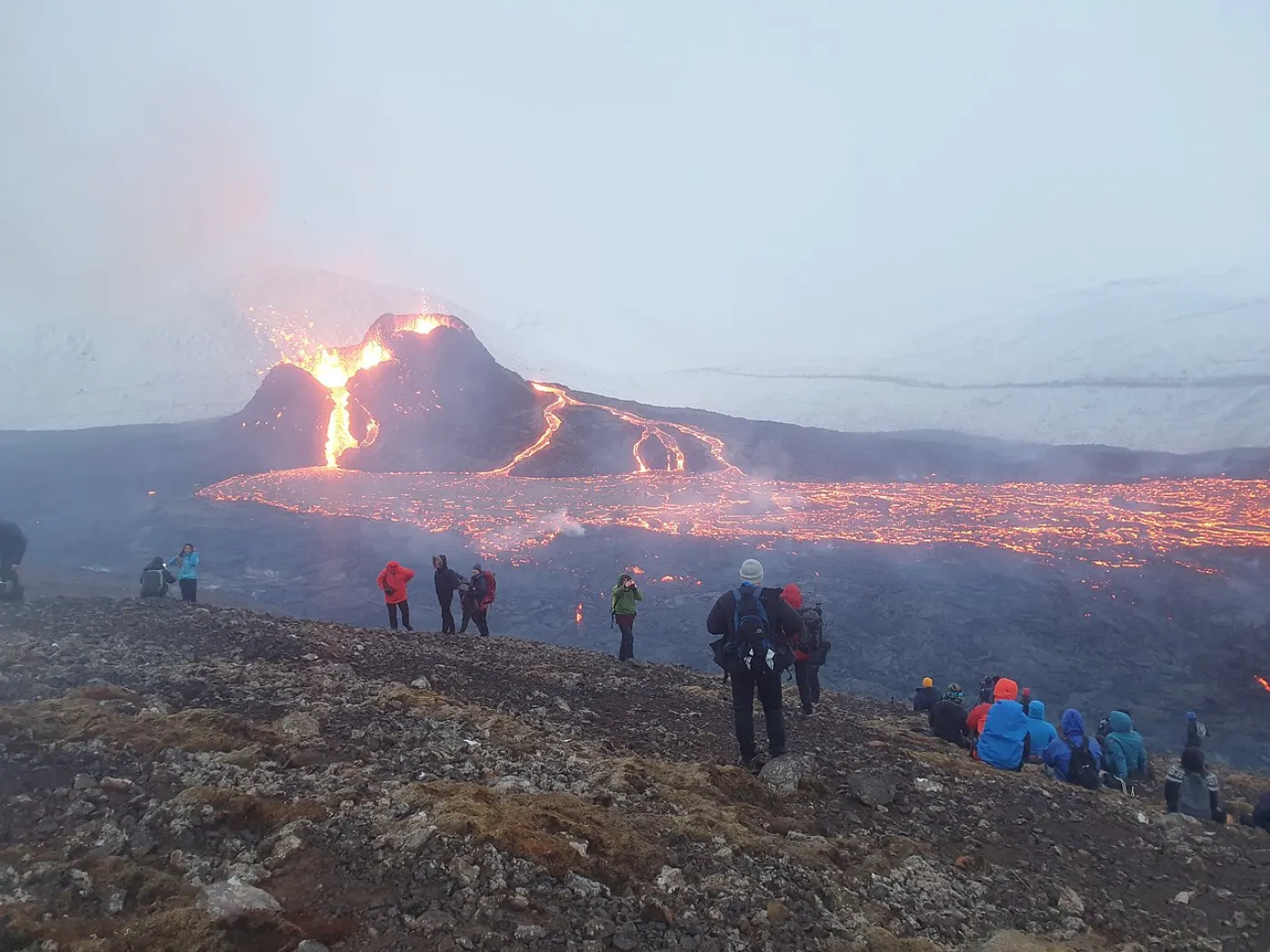
Nature The Fagradalsfjall eruption was relatively safe to watch at a distance. However, eruptions can be very dangerous.
Sure, Iceland's beauty may lie in its scenery and weather, but don't let that tempt you too much. Do not walk on glaciers without proper training and equipment, do not approach a glacier front, do not approach waves on the coast, and do not approach a large waterfall. Every year, many tourists get injured and killed by doing all of this. By being more aware of your location, your surroundings, and the dangers of Iceland's harsh nature, you can prevent a fatal incident. Glaciers and waterfalls can be enjoyed with appropriate skills, on a guided tour, or where safe areas are signposted..
...Read moreStay safeRead lessIceland is one of the places in the world with the least criminality, so there is almost no chance of getting robbed or harassed. Isolated incidents have, however, been reported, especially in Reykjavík, so it pays to take the usual precautions. Use common sense when sampling the night life.
For severe weather, volcanic eruptions etc., check alerts from Icelandic weather institution. Keep your phone on, as some alerts are sent as SMS to all mobile phones in the affected area.
AuthoritiesThe emergency phone number is 112, as in most of Europe. The police are generally polite, professional and honest, and people often comment that they are very helpful and courteous.
Nature The Fagradalsfjall eruption was relatively safe to watch at a distance. However, eruptions can be very dangerous.
Sure, Iceland's beauty may lie in its scenery and weather, but don't let that tempt you too much. Do not walk on glaciers without proper training and equipment, do not approach a glacier front, do not approach waves on the coast, and do not approach a large waterfall. Every year, many tourists get injured and killed by doing all of this. By being more aware of your location, your surroundings, and the dangers of Iceland's harsh nature, you can prevent a fatal incident. Glaciers and waterfalls can be enjoyed with appropriate skills, on a guided tour, or where safe areas are signposted..
Be prepared for sudden shifts in the weather. Weather in Iceland is unpredictable and its winters can be frigid. Do not walk out in the open in windy weather in the winter: you will become exhausted very quickly. You should make it a point to keep up to date with the country's weather and road conditions daily.
Don't go on long hikes even in summer without somebody who knows how to cope with the dangers.
Natural disastersIceland is a volcanically active country. On average, the country experiences a volcanic eruption every four years. If there is one during your stay, pay attention to local news and government warnings. Sure, it may be tempting to look at a volcanic eruption from a distance, but the eruptions can be explosive and violent. Furthermore, volcanic gas can be toxic and even lethal.
Since Iceland is situated on two shifting tectonic plates, earthquakes are quite common in Iceland. On average, the country experiences 500 earthquakes per year. Many earthquakes are small and are not that noticeable. Know this one thing: whenever there's a big earthquake, a volcanic eruption will follow.
Driving Einbreið brú: Single-lane bridge.
Driving in Iceland can be a dangerous experience. Wandering livestock, harsh weather conditions, foggy conditions, and a largely unpaved road network can make things challenging.
About a third of the country's road network is paved and many roads outside the capital are impassible during the winters (October to April) and summers. During the summers, roads can become muddy.
If you have no experience with driving in isolated areas with harsh weather conditions or knowledge of Icelandic roads, it is strongly recommended that you do not drive outside of Reykjavik. Outside the capital, help is limited, and if you do not know what you're doing, you can easily get lost or stranded.
If you absolutely must drive outside the capital, a useful resource to check out is Vegagerdin. Also, consider informing a trusted local about your plans.
DrugsThe Icelandic Narcotics Police has a very strict policy on drugs; minimum fine for possession of under 1 gram (3/100 of an ounce) of any illegal substance can result in a fine of over kr 70,000.