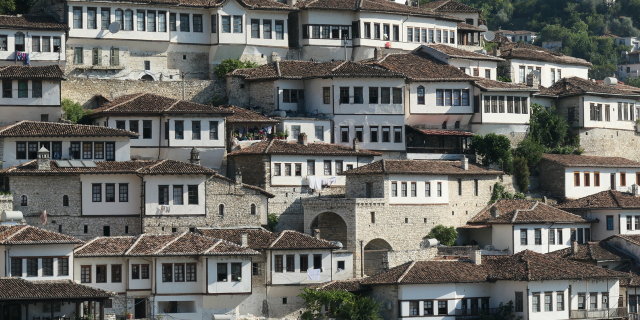

Shqipëria
AlbaniaContext of Albania
Albania ( a(w)l-BAY-nee-ə; Albanian: Shqipëri or Shqipëria), officially the Republic of Albania (Albanian: Republika e Shqipërisë), is a country in Southeast Europe. It is located in the Balkans, on the Adriatic and Ionian Seas within the Mediterranean Sea, and shares land borders with Montenegro to the northwest, Kosovo to the northeast, North Macedonia to the east and Greece to the south. With an area of 28,748 km2 (11,100 sq mi), it has a varied range of climatic, geological, hydrological and morphological conditions. Albania's landscapes range from rugged snow-capped mountains in the Albanian Alps and the Korab, Skanderbeg, Pindus and Ceraunian Mountains, to fertile lowland plains extending from the Adriatic and Ionian seacoasts. Tirana is th...Read more
Albania ( a(w)l-BAY-nee-ə; Albanian: Shqipëri or Shqipëria), officially the Republic of Albania (Albanian: Republika e Shqipërisë), is a country in Southeast Europe. It is located in the Balkans, on the Adriatic and Ionian Seas within the Mediterranean Sea, and shares land borders with Montenegro to the northwest, Kosovo to the northeast, North Macedonia to the east and Greece to the south. With an area of 28,748 km2 (11,100 sq mi), it has a varied range of climatic, geological, hydrological and morphological conditions. Albania's landscapes range from rugged snow-capped mountains in the Albanian Alps and the Korab, Skanderbeg, Pindus and Ceraunian Mountains, to fertile lowland plains extending from the Adriatic and Ionian seacoasts. Tirana is the capital and largest city in the country, followed by Durrës, Vlorë, and Shkodër.
In ancient times, the Illyrians inhabited most regions of Albania, whilst Chaonians lived in the southwest. Several important ancient Greek colonies were also established on the coast. The Illyrian kingdom centred in what is now Albania was the dominant power before the rise of Macedon. In the 2nd century BC, the Roman Republic annexed the region, and the region remained part of the eastern Roman Empire until the Middle Ages. The first known Albanian autonomous principality, Arbanon, was established in the 12th century. The Kingdom of Albania, Principality of Albania and Albania Veneta were formed between the 13th and 15th centuries in different parts of the country, alongside other Albanian principalities and political entities. In the late 15th century, Albania became part of the Ottoman Empire. In 1912, the modern Albanian state declared independence. In 1939, Italy invaded the Kingdom of Albania, which became Greater Albania, and then a protectorate of Nazi Germany during World War II. After the war, the People's Socialist Republic of Albania was formed, which lasted until the Revolutions of 1991 concluded with the fall of communism in Albania and eventually the establishment of the current Republic of Albania.
Since its independence in 1912, Albania has undergone diverse political evolution, transitioning from a monarchy to a communist regime before becoming a sovereign parliamentary constitutional republic. Governed by a constitution prioritising the separation of powers, the country's political structure includes a parliament, a ceremonial president, a functional prime minister and a hierarchy of courts. Albania is a developing country with an upper-middle income economy driven by the service sector, with manufacturing and tourism also playing significant roles. After the dissolution of its communist system the country shifted from centralised planning to an open market economy. Albanian citizens have universal health care access and free primary and secondary education. The country is an official candidate for membership in the European Union.
More about Albania
- Currency Albanian lek
- Native name Shqipëria
- Calling code +355
- Internet domain .al
- Mains voltage 220V/50Hz
- Democracy index 6.11
- Population 2811655
- Area 28748
- Driving side right
- Stay safe
Albania is generally a safe place to visit but there are some safety precautions you have to take before visiting the country.
In some Albanian cities like Berat there are no traffic lights and thus crossing on the road can be dangerous Avoid places that are deemed as slums and are sketchy, things like pickpocket can happen and also violence can occur, so avoid bringing valuables in those areas. Albania does have speed limits, but most people do not follow them. If you are driving on the highway, you have to pay extra attention to avoid car crashes . If you are not a good driver it is highly recommended that you take a bus.