
Slovenija
SloveniaContext of Slovenia
Slovenia, officially the Republic of Slovenia, is a country in Central Europe. It borders Italy to the west, Austria to the north, Hungary to the northeast, Croatia to the south and southeast, and a short coastline within the Adriatic Sea to the southwest, which is part of the Mediterranean Sea. Slovenia is mostly mountainous and forested, covers 20,271 square kilometres (7,827 sq mi), and has a population of approximately 2.1 million people. Slovene is the official language. Slovenia has a predominantly temperate continental climate, with the exception of the Slovene Littoral and the Julian Alps. Ljubljana, the capital and largest city of Slovenia, is geographically situated near the centre of the country. Other larger urban centers are Maribor, Ptuj, Kranj, Celje and Koper.
Slovenia's territory has been part of many different states: the Byzantine Empire, the Carolingian Empire, the Holy Roman Empire, the Kingdom of Hungary, the ...Read more
Slovenia, officially the Republic of Slovenia, is a country in Central Europe. It borders Italy to the west, Austria to the north, Hungary to the northeast, Croatia to the south and southeast, and a short coastline within the Adriatic Sea to the southwest, which is part of the Mediterranean Sea. Slovenia is mostly mountainous and forested, covers 20,271 square kilometres (7,827 sq mi), and has a population of approximately 2.1 million people. Slovene is the official language. Slovenia has a predominantly temperate continental climate, with the exception of the Slovene Littoral and the Julian Alps. Ljubljana, the capital and largest city of Slovenia, is geographically situated near the centre of the country. Other larger urban centers are Maribor, Ptuj, Kranj, Celje and Koper.
Slovenia's territory has been part of many different states: the Byzantine Empire, the Carolingian Empire, the Holy Roman Empire, the Kingdom of Hungary, the Republic of Venice, the Illyrian Provinces of Napoleon's First French Empire and the Habsburg Empire. In October 1918, the Slovenes co-founded the State of Slovenes, Croats, and Serbs. In December 1918, they merged with the Kingdom of Montenegro and the Kingdom of Serbia into the Kingdom of Yugoslavia. During World War II, Germany, Italy, and Hungary occupied and annexed Slovenia, with a tiny area transferred to the Independent State of Croatia, a newly declared Nazi puppet state. In 1945, it again became part of Yugoslavia. Post-war, Yugoslavia was allied with the Eastern Bloc, but after the Tito–Stalin split of 1948, it never subscribed to the Warsaw Pact, and in 1961 it became one of the founders of the Non-Aligned Movement. In June 1991, Slovenia declared independence from Yugoslavia and became an independent sovereign state.
Slovenia is a developed country, with a high-income economy characterized by a mixture of both traditional industries, such as manufacturing and agriculture, and modern sectors, such as information technology and financial services. The economy is highly dependent on foreign trade, with exports accounting for a significant portion of the country's GDP. Slovenia is a member of the Council of Europe, the European Union, the United Nations, NATO, the Organization for Security and Co-operation in Europe, and other associations in the global community.
More about Slovenia
- Currency Euro
- Native name Slovenija
- Calling code +386
- Internet domain .si
- Mains voltage 230V/50Hz
- Democracy index 7.54
- Population 1913355
- Area 20271
- Driving side right
- Stay safe
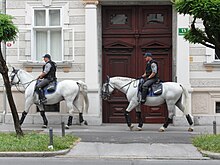 Mounted police in Ljubljana
Slovenia is one of the safest countries you can visit, but be aware of your surroundings in parts of Ljubljana.
The nationwide emergency number is 112. To call police, dial 113. There are emergency telephones interspersed along the main motorways. You can find the closest SOS-phone by the arrows on the reflection posts.
People may get a bit aggressive in crowded bars and discothèques, and it is not uncommon to be grabbed or groped.
Petty theft can occur everywhere. Don't worry about it, just don't leave your watch on the car seat while you go kayaking.


![[node:title]](/sites/default/files/styles/640x320/public/default_images/default_0.JPG.webp?itok=aqV9zhFR)