

Malaysia
Context of Malaysia
Malaysia is a country in Southeast Asia. A federal constitutional monarchy, it consists of 13 states and three federal territories, separated by the South China Sea into two regions: Peninsular Malaysia and Borneo's East Malaysia. Peninsular Malaysia shares a land and maritime border with Thailand and maritime borders with Singapore, Vietnam, and Indonesia. East Malaysia shares land borders with Brunei and Indonesia, as well as a maritime border with the Philippines and Vietnam. Kuala Lumpur is the national capital, the country's largest city, and the seat of the legislative branch of the federal government. Putrajaya is the federal administrative capital, which represents the seat of both the executive branch (the Cabinet, federal ministries, and federal agencies) and the judicial branch of the federal government. With a population of over 34 million, the country is the world's 42nd-most populous country. Malaysia is tropical and is one of 1...Read more
Malaysia is a country in Southeast Asia. A federal constitutional monarchy, it consists of 13 states and three federal territories, separated by the South China Sea into two regions: Peninsular Malaysia and Borneo's East Malaysia. Peninsular Malaysia shares a land and maritime border with Thailand and maritime borders with Singapore, Vietnam, and Indonesia. East Malaysia shares land borders with Brunei and Indonesia, as well as a maritime border with the Philippines and Vietnam. Kuala Lumpur is the national capital, the country's largest city, and the seat of the legislative branch of the federal government. Putrajaya is the federal administrative capital, which represents the seat of both the executive branch (the Cabinet, federal ministries, and federal agencies) and the judicial branch of the federal government. With a population of over 34 million, the country is the world's 42nd-most populous country. Malaysia is tropical and is one of 17 megadiverse countries; it is home to numerous endemic species. Tanjung Piai in the Malaysian state of Johor is the southernmost point of continental Eurasia.
The country has its origins in the Malay kingdoms, which, from the 18th century on, became subject to the British Empire, along with the British Straits Settlements protectorate. During World War II, British Malaya, along with other nearby British and American colonies, was occupied by the Empire of Japan. Following three years of occupation, Peninsular Malaysia was briefly unified as the Malayan Union in 1946 until 1948 when it was restructured as the Federation of Malaya. The country achieved independence on 31 August 1957. On 16 September 1963, independent Malaya united with the then British crown colonies of North Borneo, Sarawak, and Singapore to become Malaysia. In August 1965, Singapore was expelled from the federation and became a separate, independent country.
The country is multiethnic and multicultural, which has a significant effect on its politics. About half the population is ethnically Malay, with minorities of Chinese, Indians, and indigenous peoples. The official language is Malaysian Malay, a standard form of the Malay language. English remains an active second language. It is also home to 111 living indigenous languages. While recognising Islam as the official religion, the constitution grants freedom of religion to non-Muslims. The government is modelled on the Westminster parliamentary system, and the legal system is based on common law. The head of state is an elected monarch, chosen from among the nine state sultans every five years. The head of government is the prime minister.
The country's economy has traditionally been driven by its natural resources but is expanding into commerce, tourism, and medical tourism. The country has a newly industrialised market economy, which is relatively open and state-oriented. The country is a founding member of the Organisation of Islamic Cooperation (OIC), the East Asia Summit (EAS), and the Association of Southeast Asian Nations (ASEAN), and a member of the Non-Aligned Movement (NAM), the Commonwealth, and the Asia-Pacific Economic Cooperation (APEC).
More about Malaysia
- Currency Malaysian ringgit
- Calling code +60
- Internet domain .my
- Mains voltage 240V/50Hz
- Democracy index 7.19
- Population 32447385
- Area 330803
- Driving side left
- Stay safe
Emergency numbers
Central emergency number 999
Though the crime rate is higher than in neighbouring Singapore, Malaysia is generally a safe country for visitors. Crimes towards tourists are usually restricted to bag-snatching, pickpocketing and petty theft. It is important to keep a close eye on valuable items. Theft is more common in crowded places, such as markets and on public transport. Generally, if you avoid deserted areas, get back to your hotel before midnight and use your common sense, you're unlikely to be assaulted. Homosexuality is a crime and gay bars may be raided by police; gay and lesbian tourists should be self-aware and careful.
...Read moreStay safeRead lessEmergency numbers
Central emergency number 999
Though the crime rate is higher than in neighbouring Singapore, Malaysia is generally a safe country for visitors. Crimes towards tourists are usually restricted to bag-snatching, pickpocketing and petty theft. It is important to keep a close eye on valuable items. Theft is more common in crowded places, such as markets and on public transport. Generally, if you avoid deserted areas, get back to your hotel before midnight and use your common sense, you're unlikely to be assaulted. Homosexuality is a crime and gay bars may be raided by police; gay and lesbian tourists should be self-aware and careful.
Crime WARNING: Malaysia treats drug offences extremely severely. The death penalty is mandatory for those convicted of trafficking, manufacturing, importing or exporting more than 15 g of heroin, 30 g of morphine, 30 g of cocaine, 500 g of cannabis, 200 g of cannabis resin and 1.2 kg of opium, and possession of these quantities is all that is needed for you to be convicted.
Unauthorised consumption can result in up to 10 years' jail, or a heavy fine, or both. You can be charged for unauthorised consumption as long as traces of illicit drugs are found in your system, even if you can prove that they were consumed outside the country and you can be charged for trafficking as long as drugs are found in bags that are in your possession or in your room, even if they aren't yours and regardless of whether you're aware of them - therefore be vigilant of your possessions.
There have been some reports of pickpockets and snatch-and-run thieves in some of the major cities like Kuala Lumpur, Petaling Jaya and Johor Bahru. As a general precaution, never carry your bags on the side facing the road and always walk facing the oncoming traffic. Additionally, walk a few feet deeper away from the roads. Women travellers should take extra precautions at night.
Johor Bahru is known for having a relatively higher crime rate compared to the rest of Malaysia, and armed robberies and snatch thefts could happen at night in run-down areas of the city. Travel documents and valuables are best deposited in a hotel safe.
In Malaysia, some crimes are punished with caning. Being convicted of rape, vandalism, illegal entry, bribery, overstaying your visa, and certain other crimes could get you caned. This is no slap on the wrist! Strokes from the thick rattan cane are very painful, will take some time to heal and probably leave you with a permanent scar.
Credit card fraud is a growing problem in this country, especially if you order in an on-line store during your stay. Use credit cards only in reputable shops. If you are not sure about the reputation of a certain shop or service, there are several services available that can help to identify fraud and scams such as Trustedcompany.com for any online service they want to use.
CorruptionWhile not as bad as the likes of Thailand, Vietnam or Indonesia, corruption remains a significant issue in Malaysia. Traffic police have been known to pull over motorists to demand bribes of RM100-200; this tends to happen somewhat more often to those driving Singapore-registered cars (recognisable by the licence plates). Nevertheless, there have been some crackdowns on this, and bribery is punishable by up to 20 years in jail. Anyone who tries to bribe public officials may be arrested on the spot and placed in a lock-up overnight to be charged for the offence in the morning. If this happens on a Friday or on eve of public holidays, you will find yourself spending a few nights in the lock-up as the courts are only open Monday to Friday. Do not let this dissuade you from requesting help — generally Malaysian police are helpful to tourists.
Customs and immigration officers are generally fairly clean, and unlike in other mainland Southeast Asian countries, being asked to pay a bribe to get your passport stamped is virtually unheard of, even at land border crossings. (Thai immigration on the other side of the border is another story though). Do check your passport before driving off when entering by land from the Singapore border though, as immigration officers have been known to "forget" to stamp people in, and you will be subject to fines of several thousand ringgit for illegal entry when you try to leave Malaysia if your passport was not stamped on entry.
Traffic safetyDrunk-driving is a serious offense and breathalyzer tests by the police are common.
When on foot, be careful when crossing the street. Vehicles will often ignore pedestrian (zebra) crossings. However, reports of road bullying during accidents are still common, so if you are involved in an accident be very careful when negotiating or dial 999 for help.
Other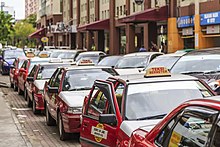 Taxis in Kota Kinabalu, Sabah.
Many taxis will refuse to use the meter, even though there is an official rate. Most taxis now have a sticker on the rear door informing tourists that haggling is prohibited. Taxi drivers, sensing that you are a tourist, may drive around and take a very long route to reach your destination.
If you need a taxi late at night, it is best to use the dial-a-taxi service as there have been incidents in which taxis flagged down during those hours have been fake/unregistered. An unregistered taxi driver might rob or assault you with the help of other assailants. You are also more likely to get a metered taxi by flagging one at a street than at a taxi stand.
It is advisable to study maps and compare fares on the internet before visiting the country. Knowing distances between places is helpful when negotiating with taxi drivers. They won't try to fool even a foreigner who demonstrates clearly that he knows the distance from point A to point B is 50 km and not 150 km.
Do not accept the first rates for inter-city travels by car offered by hotels, as these could be as much as double normal prices. In this case, negotiate with a taxi driver directly for a better and fair price (for example, a hotel near Balok Beach, not very far from Kuantan, asked 800 RM for a ride to Johor Bahru, while a negotiated price with a taxi driver who could be found in downtown Kuantan came down to a normal 400 RM). But for all this you need to know the exact distance and if possible even the exact itinerary between your departure and arrival point.
Public demonstrations are uncommon in Malaysia due to police crackdowns. Should one occur it may be dealt with in a heavy-handed manner, so avoid them at all costs.
Finally, it is generally not allowed for non-Muslims or non-Sunnis to proselytize. In particular, attempting to persuade Muslims to convert out of their religion is illegal, and if you are caught doing this, you will at best be expelled from the country.
Natural disastersPeninsular Malaysia is largely free from earthquakes as there are no nearby faultlines, though tremors can occasionally be felt in the upper storeys of tall buildings when a major quake occurs in neighbouring Indonesia. East Malaysia, on the other hand, especially the area around Mount Kinabalu, does experience occasional earthquakes (such as the fatal one occurring in 2015). Typhoons are also exceedingly rare, though one hit the southern part of Johor in 2001. However, the Nov-Jan monsoon season often results in flooding due to torrential rains, and landslides are known to occur, most notably on the East Coast. Tsunamis are a rare occurrence, though Penang and a few islands on the north of the West Coast were hit by the infamous tsunami in 2004.


![[node:title]](/sites/default/files/styles/640x320/public/default_images/default_0.JPG.webp?itok=aqV9zhFR)


