
Suomi
FinlandContext of Finland
Finland, officially the Republic of Finland, is a Nordic country in Northern Europe. It borders Sweden to the northwest, Norway to the north, and Russia to the east, with the Gulf of Bothnia to the west and the Gulf of Finland to the south, opposite Estonia. Finland has a population of 5.6 million. Its capital and largest city is Helsinki. The majority of the population are ethnic Finns. The official languages are Finnish and Swedish; 84.1 percent of the population speak the first as their mother tongue and 5.1 percent the latter. Finland's climate varies from humid continental in the south to boreal in the north. The land cover is predominantly boreal forest biome, with more than 180,000 recorded lakes.
Finland was first settled around 9000 BC after the last Ice Age. During the Stone Age, various cultures emerged, distinguished by different styles of ceramics. The Bronze Age and Iron Ages were marked by contacts with other cult...Read more
Finland, officially the Republic of Finland, is a Nordic country in Northern Europe. It borders Sweden to the northwest, Norway to the north, and Russia to the east, with the Gulf of Bothnia to the west and the Gulf of Finland to the south, opposite Estonia. Finland has a population of 5.6 million. Its capital and largest city is Helsinki. The majority of the population are ethnic Finns. The official languages are Finnish and Swedish; 84.1 percent of the population speak the first as their mother tongue and 5.1 percent the latter. Finland's climate varies from humid continental in the south to boreal in the north. The land cover is predominantly boreal forest biome, with more than 180,000 recorded lakes.
Finland was first settled around 9000 BC after the last Ice Age. During the Stone Age, various cultures emerged, distinguished by different styles of ceramics. The Bronze Age and Iron Ages were marked by contacts with other cultures in Fennoscandia and the Baltic region. From the late 13th century, Finland became part of Sweden as a result of the Northern Crusades. In 1809, as a result of the Finnish War, Finland was captured from Sweden and became an autonomous grand duchy within the Russian Empire. During this period, Finnish art flourished and the independence movement began to take hold. Finland became the first territory in Europe to grant universal suffrage in 1906, and the first in the world to give all adult citizens the right to run for public office. Following the Russian Revolution of 1917, Finland declared its independence. A civil war was fought in Finland the following year, with the Whites emerging victorious. Finland's status as a republic was confirmed in 1919. During World War II, Finland fought against the Soviet Union in the Winter War and the Continuation War, and later against Nazi Germany in the Lapland War. As a result, it lost parts of its territory to the Soviet Union but retained its independence and democracy.
Finland remained a largely agricultural country until the 1950s. After World War II, it industrialised quickly and established an advanced economy, with a welfare state built on the Nordic model. This allowed the country to experience overall prosperity and high per capita income. During the Cold War, Finland officially embraced a policy of neutrality. Since then, it has become a member of the European Union in 1995, the Eurozone in 1999, and following the Russian invasion of Ukraine, joined NATO in 2023. Finland is a member of various international organisations, such as the Nordic Council, the Schengen Area, and the Organisation for Economic Co-operation and Development (OECD). The nation performs extremely well in national performance metrics, including education, economic competitiveness, civil liberties, quality of life, and human development.
More about Finland
- Currency Euro
- Native name Suomi
- Calling code +358
- Internet domain .fi
- Mains voltage 230V/50Hz
- Democracy index 9.2
- Population 5608218
- Area 305396
- Driving side right
- Stay safe
Risks in Finland
...Read more
Crime/violence: Low
Most violence is alcohol-related and/or domestic – walking in the street is usually safe even in the night
Authorities/corruption: Low
The police are generally courteous and speak some (or good) English. They don't take bribes.
Transportation: Low to Moderate
Icy roads and pavements in the winter, moose and other animals occasionally crossing the roads
Health: Low
Tick and mosquito bites
Nature: Low to Moderate
Blizzards in the winter, getting lost when hiking in the forestsStay safeRead lessRisks in Finland
Crime/violence: Low
Most violence is alcohol-related and/or domestic – walking in the street is usually safe even in the night
Authorities/corruption: Low
The police are generally courteous and speak some (or good) English. They don't take bribes.
Transportation: Low to Moderate
Icy roads and pavements in the winter, moose and other animals occasionally crossing the roads
Health: Low
Tick and mosquito bites
Nature: Low to Moderate
Blizzards in the winter, getting lost when hiking in the forestsCrime Note: Although Finland borders to Russia and is sympathetic to Ukraine, there is no threat towards Finland, and should not be towards Russians in Finland. Most people understand that the war is not the fault of the Russian people, but of the regime. Still, you might want to avoid speaking Russian where people may be drunk and aggressive.
(Information last updated 07 Mar 2022)
Note: Although Finland borders to Russia and is sympathetic to Ukraine, there is no threat towards Finland, and should not be towards Russians in Finland. Most people understand that the war is not the fault of the Russian people, but of the regime. Still, you might want to avoid speaking Russian where people may be drunk and aggressive.
(Information last updated 07 Mar 2022)
Finland enjoys a comparatively low crime rate and is, generally, a very safe place to travel. Parents often leave their sleeping babies in a baby carriage on the street while visiting a shop, and in the countryside cars and house doors are often left unlocked. There are no no-go neighbourhoods even in the night.
Use common sense at night, particularly on Friday and Saturday when the youth of Finland hit the streets to get drunk and in some unfortunate cases look for trouble. Don't leave valuables or your drink unguarded at night clubs.
Racism is generally a minor concern for tourists, especially in the cosmopolitan major cities, but some drunk people looking for trouble may be more likely to target foreign looking people. Avoiding arguments with drunk gangs may be more important if you fit that description. Immigration to Finland was quite limited before the 1990s and not everybody has got used to the globalisation.
Pickpockets used to be rare, but nowadays the situation has changed, especially in the busy tourist months in the summer, when organised pickpockets arrive from Eastern Europe. In restaurants, do not ever leave your phone, laptop, tablet, keys or wallet unattended. There have been some cases in Helsinki where thieves have been targeting breakfast buffets in hotels, where people often leave valuables unguarded for a few minutes. Regardless of that, most Finns carry their wallets in their pockets or purses and feel quite safe while doing it.
Bicycle thieves are everywhere, never leave your bike unlocked even for a minute.
Finnish police (poliisi/polis) are respected by the public, respectful even to drunkards and thieves, and not corrupt. Should something happen, do not hesitate to get in contact with them. In addition to the police proper, the border guard (rajavartiolaitos/gränsbevakningsväsendet) and customs officials (tulli/tull) have police powers; the border guard acts on behalf of the police in some sparsely populated areas. All these should normally be in uniform.
In the case a police officer actually approaches you, staying calm and polite will help keep the situation on the level of discussion. They have the right to check your identity and your right to stay in the country. They might ask strange questions like where are you coming from, where are you heading next, where you stay or whether you have seen, met or know somebody. If you feel that some question could compromise your privacy, feel free to politely say so. Finnish police have wide powers for arrest and search, but they are unlikely to abuse them. If the situation deteriorates, however, they will probably take you in custody, with force if needed.
Whatever happens, remember that Finland is one of the world's least corrupt countries. Suggestion of bribes will be met by astonishment or worse. If you get fined, payment on the spot is never expected or even possible. A "police" asking for money would be a dead giveaway that they aren't real police.
Customs and the police are strict on drugs, including cannabis. Sniffer dogs are used in ports and airports and a positive marking will always result in a full search. Cannabis use is not generally tolerated among the population.
Prostitution is not illegal and is mostly unregulated. However, there are no brothels, as pimping is illegal. It is also illegal to use the services of a prostitute who is a victim of human trafficking.
Nature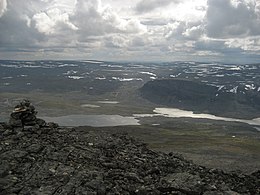 You don't want to get lost here! Some snow remaining in late July, 20 km to nearest village
There are few serious health risks in Finland. Your primary enemy will be the cold, especially in wintertime and at sea.
Finland is a sparsely populated country and, if heading out into the wilderness, it is imperative that you register your travel plans with somebody who can inform rescue services if you fail to return. Always keep your mobile phone with you if you run into trouble. Dress warmly in layers and bring along a good pair of sunglasses in the snowy times to prevent snow blindness, especially in the spring and if you plan to spend whole days outdoors. Always keep a map, a compass and preferably a GPS with you while trekking in the wilderness. Take extra precautions in Lapland, where it can be several days' hike to the nearest house or road. Weather can change rapidly, and even though the sun is shining now, you can have a medium sized blizzard on your hands (no joke!) an hour or two later. Although weather forecast generally are of good quality, there are circumstances where the weather is hard to predict, especially in regions with fells or islands. Also remember that many forecasts only cite day temperatures, while it often is 10–15°C (20–30°F) colder in the night and early morning.
If out on the lakes and sea, remember that wind and water will cool you faster than cold air, and keeping dry means keeping warm. A person that falls into water close to freezing has to be saved quickly, and even in summer water will cool you pretty soon. If you jump into water, first check there isn't any half-submerged log to hit with your head. Safety in small boats: Don't drink alcohol, keep seated and wear a life vest at all times. If your boat capsizes – keep clothes on to stay warm and cling to the boat. Small boats are made to be unsinkable.
In winter, lakes and the sea are frozen. Walking, skating or even driving a car on the ice is commonly seen, but fatal accidents are not unheard of either, so ask and heed local advice. If the ice fails, it is difficult to get back out of the water, as the ice will be slippery. Ice picks are sold as safety equipment (a pair of steel needles with bright plastic grips, connected with a safety line). Stay calm, shout for help, break the ice in the direction you came from, get up, creep away and get indoors with no delay. Help from somebody with a rope, a long stick or any similar improvised aid might be needed (no use having both of you in the water).
The most important poisonous insects in Finland are wasps (ampiainen/geting), hornets (herhiläinen/bålgeting), bees (mehiläinen/bi) and bumblebees (kimalainen/humla). Their stings can be painful, but are not dangerous, unless you receive many stings or a sting by the trachea (do not lure a wasp onto your sandwich!) or if you are extremely allergic to it. In late summer, wasps can become a nuisance, but otherwise these insects tend to leave people alone if not disturbed.
There is only one type of poisonous snake in Finland, the European adder (Finnish: kyy or kyykäärme/huggorm). Their bites are very rarely fatal (although dangerous to small children and allergic persons), but one should be careful in the summertime. If you are bitten by a snake, always get medical assistance; stay calm and call 112 to get advice.
As for other dangerous wildlife, brown bears (karhu/björn), wolves (susi/varg), lynxes (ilves/lo), and wolverines (ahma/järv) occur across Finland, but you are lucky if you see any of these large carnivores! Talking with your company while in the forest should be enough to make them keep away, especially to avoid getting between a bear and her cubs. If you do see a bear, back off calmly.
Also keep your distance to other wildlife, such as elk. Bulls can become aggressive and charge at humans, as can cows defending their calves. The worst risk is however running into one on the road. In Lapland, Northern Ostrobothnia, and Kainuu there is risk for reindeer collisions. They often linger peacefully on the road; if you see one reindeer anywhere near the road, reduce your speed immediately and understand there are more of them around. Always call 112 after a collision even if you did not get hurt, as the animal probably did.
In case of emergency112 is the national phone number for all emergency services, including police and social services, and it does not require an area code, regardless of what kind of phone you are using. The number works on any mobile phone, whether it is keylocked or not, and with or without a SIM card. If a cellphone challenges you with a PIN code, you can simply type in 112 as a PIN code – most phones will give a choice to call the number (or call without asking). The operator will answer in Finnish or Swedish, but your switching to English should be no problem.
There is a 112 app, which will use your GPS to get your position when you use it to call the emergency services. The app knows also some related phone numbers. The updated version is available for android and iPhone in the respective app stores. Have it installed before you need it! It relies on mobile data, so is not reliable in some remote areas, and the GPS position is unreliable unless the GPS has been on for some time. But along the main roads, where you are most likely not to know your position, mobile coverage is good.
For inquiries about poisons or toxins (from mushrooms, plants, medicine or other chemicals) call the national Toxin Information Office at +358 9 471-977. Finns often have an "adder kit" (kyypakkaus, 50 mg hydrocortisone) at their cottages, although this is not enough by itself except perhaps for bee or wasp stings; with an adder bite, one should call 112 with no undue delay.
The time for help to arrive can be quite long in sparsely populated areas (around an hour, more in extreme areas; in cities just minutes), so it makes sense to have basic first-aid supplies at hand when visiting cottages or the wilderness. First aid training is quite common, so amateur help may be available. In case of cardiac arrest, public defibrillators (Finnish: defibrillaattori) are often available; still begin CPR immediately to the best of your ability, after telling someone to call 112.


