

Brasil
BrazilContext of Brazil
Brazil, officially the Federative Republic of Brazil, is the largest country in South America. It is the world's fifth-largest country by area and the seventh-largest by population, with over 212 million people. The country is a federation composed of 26 states and a Federal District, which hosts the capital, Brasília. Its most populous city is São Paulo, followed by Rio de Janeiro. Brazil has the most Portuguese speakers in the world and is the only country in the Americas where Portuguese is an official language.
Bounded by the Atlantic Ocean on the east, Brazil has a coastline of 7,491 kilometers (4,655 mi). Covering roughly half of South America's land area, it borders all other countries and territories on the continent except Ecuador and Chile. Brazil encompasses a wide range of tropical and subtropical landscapes, as well as wetlands, savannas, plateaus, and low mountains. It contains most of the Amazon basin, including th...Read more
Brazil, officially the Federative Republic of Brazil, is the largest country in South America. It is the world's fifth-largest country by area and the seventh-largest by population, with over 212 million people. The country is a federation composed of 26 states and a Federal District, which hosts the capital, Brasília. Its most populous city is São Paulo, followed by Rio de Janeiro. Brazil has the most Portuguese speakers in the world and is the only country in the Americas where Portuguese is an official language.
Bounded by the Atlantic Ocean on the east, Brazil has a coastline of 7,491 kilometers (4,655 mi). Covering roughly half of South America's land area, it borders all other countries and territories on the continent except Ecuador and Chile. Brazil encompasses a wide range of tropical and subtropical landscapes, as well as wetlands, savannas, plateaus, and low mountains. It contains most of the Amazon basin, including the world’s largest river system and most extensive virgin tropical forest. Brazil has diverse wildlife, a variety of ecological systems, and extensive natural resources spanning numerous protected habitats. The country ranks first among 17 megadiverse countries, with its natural heritage being the subject of significant global interest, as environmental degradation (through processes such as deforestation) directly affect global issues such as climate change and biodiversity loss.
Brazil was inhabited by various indigenous peoples prior to the landing of Portuguese explorer Pedro Álvares Cabral in 1500. It was claimed and settled by Portugal, which imported enslaved Africans to work on plantations. Brazil remained a colony until 1815, when it was elevated to the rank of a united kingdom with Portugal after the transfer of the Portuguese court to Rio de Janeiro. Prince Pedro of Braganza declared the country's independence in 1822, establishing the Empire of Brazil, a unitary state governed under a parliamentary constitutional monarchy. Brazil's first constitution in 1824 established a bicameral legislature, now called the National Congress, and enshrined principles such as freedom of religion and the press, but retained slavery, which was gradually abolished throughout the 19th century until its final abolition in 1888. Brazil became a presidential republic following a military coup d'état in 1889. An armed revolution in 1930 put an end to the First Republic and brought Getúlio Vargas to power. While initially committing to democratic governance, Vargas assumed dictatorial powers following a self-coup in 1937, marking the beginning of the Estado Novo. Democracy was restored after Vargas' ousting in 1945. An authoritarian military dictatorship emerged in 1964 and ruled until 1985, after which civilian governance resumed. Brazil's current constitution, enacted in 1988, defines it as a democratic federal republic.
Brazil is a regional and middle power and rising global power. It is an emerging, upper-middle income economy and newly industrialized country, with one of the 10 largest economies in the world in both nominal and PPP terms, the largest economy in Latin America and the Southern Hemisphere, and the largest share of wealth in South America. With a complex and highly diversified economy, Brazil is one of the world's major or primary exporters of various agricultural goods, mineral resources, and manufactured products. Due to its rich culture and history, the country ranks thirteenth in the world by number of UNESCO World Heritage Sites. Brazil is a founding member of the United Nations, the G20, BRICS, G4, Mercosur, Organization of American States, Organization of Ibero-American States, and the Community of Portuguese Language Countries; it is also an observer state of the Arab League and a major non-NATO ally of the United States.
More about Brazil
- Currency Brazilian real
- Native name Brasil
- Calling code +55
- Internet domain .br
- Mains voltage 220V/60Hz
- Democracy index 6.92
- Population 203062512
- Area 8515767
- Driving side right
- Stay safe
 WARNING: Traveling to the border area with Venezuela and Colombia (with the exception of the Brazilian city of Tabatinga at the Colombian border) is not safe due to threats of violence and kidnapping by drug traffickers and armed groups....Read moreStay safeRead less“ O Brasil não é para principiantes.
WARNING: Traveling to the border area with Venezuela and Colombia (with the exception of the Brazilian city of Tabatinga at the Colombian border) is not safe due to threats of violence and kidnapping by drug traffickers and armed groups. A high degree of caution is also recommended when traveling to Rio de Janeiro due to the high levels of crime.
Government travel advisories(Information last updated 27 Apr 2022)Australia Canada Ireland New Zealand United Kingdom United States
WARNING: Traveling to the border area with Venezuela and Colombia (with the exception of the Brazilian city of Tabatinga at the Colombian border) is not safe due to threats of violence and kidnapping by drug traffickers and armed groups....Read moreStay safeRead less“ O Brasil não é para principiantes.
WARNING: Traveling to the border area with Venezuela and Colombia (with the exception of the Brazilian city of Tabatinga at the Colombian border) is not safe due to threats of violence and kidnapping by drug traffickers and armed groups. A high degree of caution is also recommended when traveling to Rio de Janeiro due to the high levels of crime.
Government travel advisories(Information last updated 27 Apr 2022)Australia Canada Ireland New Zealand United Kingdom United States
"Brazil's not for beginners." ”—Tom Jobim, Brazilian musician
By law, everyone must carry a photo ID at all times. For a foreigner, this means your passport. However, the police will mostly be pragmatic and accept a plastified color photocopy. Not carrying a photo ID can lead to problems and delays if stopped by police or in case of a medical emergency.
Crime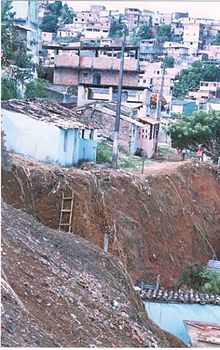 Cidade de Deus favela in Rio, where the eponymous movie was set
Brazil is one of the most criminalised countries in the world; therefore, the crime rate is high. Even though the homicide rate fell by more than 10% in 2018, the country still has one of the highest rates in the world. Pick-pocketing and theft are rampant, but perhaps what is more scary to visitors - and also depressingly common - are robberies at gunpoint, which target both locals and tourists. There are cases of armed criminals attacking hotels (from guesthouses to luxurious resorts) and even package tour buses, and armed robberies in crowded areas at plain daylight.
Most visitors to Brazil have trips without any incidents, and a few precautions can drastically reduce the likelihood of being victim of crime. Even with those precautions, though, the chance of a bad incident may still not be negligible. Check the individual city/area articles for advice on specific cities or places. Generally speaking, with exception of a few prosperous countryside areas and smaller towns (mostly in the southern part of the country), most areas in Brazil aren't extremely safe, so it is advisable to avoid showing off expensive possessions in public areas, to avoid deserted streets during the night, and especially, to avoid poor, run-down towns or neighbourhoods. There are cases of Brazilians or tourists being shot down without warning when entering certain neighbourhoods, either in a car or on foot. If you want to visit a favela (slum neighbourhood) or indigenous village, use a licensed, reputable tour service.
Intercity buses are generally safe, but in large cities, intercity bus terminals are often located in run-down, unsafe areas of the city, so it is prudent to take a taxi to and from the terminal rather than walk to or from it. In touristy places, tourists are often seen as "preferred prey" for criminals, so it is better to avoid looking like a tourist. For example, avoid being seen carrying a large camera or guidebook (leave them in a backpack and use them discreetly only when necessary), or dressing in a way dramatically different from the locals. It is perfectly fine to sometimes stop locals to ask questions, but avoid looking clueless and vulnerable when in public.
Emergencies related to crime can be reported to toll-free number 190. Brazil has five police forces, one for each different purpose. Each state has a Military Police (Polícia Militar, often abbreviated as PME*, where * is the abbreviation of the state. In the state of Rio Grande do Sul, Brigada Militar, abbreviated as BMRS), which is responsible for ostensive policing, and a Civil Police (Polícia Civil, often abbreviated as PCE*, where * is the abbreviation of the state.), which deals with investigations. In state and federal highways, road patrol is handled by the State Highway Police (Polícia Rodoviária Estadual) and the Federal Highway Police (Polícia Rodoviária Federal). Border control, security of ports and airports, and interstate crimes are handled by the Federal Police (Polícia Federal). Many municipalities in Brazil also have a Municipal Guard (Guarda Municipal), which is responsible for the security of public parks, city government buildings and city public schools.
Road safetyMurder is probably the top fear of visitors to Brazil, but traffic-related deaths are actually nearly as common as murders - in fact, the chance of a road fatality in Brazil is comparable to countries with poor road safety reputation, like Malaysia or Vietnam. This may come as a surprise as the traffic in Brazil, especially in large cities, appears to be relatively well-organised compared to these countries. However, this apparent sense of safety is where the danger lurks - Brazil has a large share of irresponsible drivers, who defy speed limits, drive under the influence of alcohol, and sometimes ignore traffic lights. Therefore, always keep your eyes open when crossing the road, even when the pedestrian light is green and the cars have stopped - you never know when a motorbike will pop up from between two cars.
In certain parts of the country, especially in the northern part, roads tend to be poor-maintained, and enforcement of traffic regulations tend to be lax. Although sometimes unavoidable, it is worthwhile to re-consider taking very long road trips inside the country when there is the option of taking a plane instead.
Natural hazardsAs Brazil is a very large country and has a wide geographical and climatic diversity, parts of the country can be affected by natural disasters.
Floods and landslidesIn the Amazon, the rainy season occurs between December and May, bringing torrential rains and frequent flooding in these regions, which can make the highways (which are not paved) a real quagmire impossible to transit. However, it can still be a good time to visit some of the well-populated and tourist-oriented areas and, except in unusually strong floods, you can still see the strong waterfalls, igapós and other attractions in the forest that can make an interesting moment to visit.
Floods in the semi-arid Sertão, in the inland of the Northeast region, are rare, so you would be unlucky to find them. However, if you are planning to visit a city in the Sertão and the area is flooded, you should reconsider. The terrain is flat, so the water can take weeks to drain, leaving the land swampy.
The rainiest period in the Central West is generally around the summer months, from early October to April. Some cities can have points of flooding. On the northeastern coast and in the Southeast region of the country, including Salvador, Recife, Rio de Janeiro, São Paulo and Belo Horizonte, the rainiest period is summer months. Torrential rains in the region can cause floods and catastrophic landslides, including in tourist areas. In São Paulo, as the city is cut by the rivers Tietê and Pinheiros and the soil is impermeable, making the water slow to drain. In mountainous areas in the southeast of the country, landslides can disrupt roads and cause damage.
EarthquakesAs Brazil is located in the center of the South American plate, Brazil does not usually have earthquakes of great intensity and many of them are imperceptible by the population (below 3.0 degrees on the Richter scale).
HurricanesBrazil is a difficult country for hurricanes reach, as wind shear is rare in countries close to the Equator and the temperature of the ocean reaches just 26º C on the northeast coast. The only tropical storm that has ever occurred in Brazil was Hurricane Catarina, in 2004, which hit the coast of the states of Rio Grande do Sul and Santa Catarina. Even so, cases like this are very rare in Brazil.
TornadoesThe Brazilian states of Rio Grande do Sul, Santa Catarina, the center and south of the state of Paraná and the south of the state of São Paulo are part of the South America Tornado Corridor, the second most tornado-prone area in the world (behind the United States Tornado Alley). Monitor local media notices and if you see that the sky is dark, the light take on a greenish-yellow cast or a loud sound that sounds like a freight train, this could be an indication of a tornado. Find shelter immediately.
Refer to the tornado safety article for analysis of the issues here.
WildfiresLow humidity during the dry season in the Pantanal, in the Brazilian Central West (including the states of Mato Grosso, Mato Grosso do Sul, Goiás and in Brasília) between May and October can lead to forest fires. If you have breathing problems and are visiting these areas, it is recommended to monitor information from the local media and avoid the areas of fires.
DemonstrationsDemonstrations and political protests are common in Brazil and are best avoided by tourists, as these demonstrations can sometimes become violent and end in clashes with the Military Police, especially when approaching city, state or federal government buildings. The majority of popular demonstrations usually take place in the capitals such as São Paulo (in places like Largo da Batata, Avenida Paulista and Praça da Sé), Rio de Janeiro (Cinelândia and Copacabana Beach), Brasília (Eixo Monumental and Esplanada dos Ministérios) or Porto Alegre (Esquina Democrática and the Historic District).




![[node:title]](/sites/default/files/styles/640x320/public/default_images/default_0.JPG.webp?itok=aqV9zhFR)


